Quick Answer
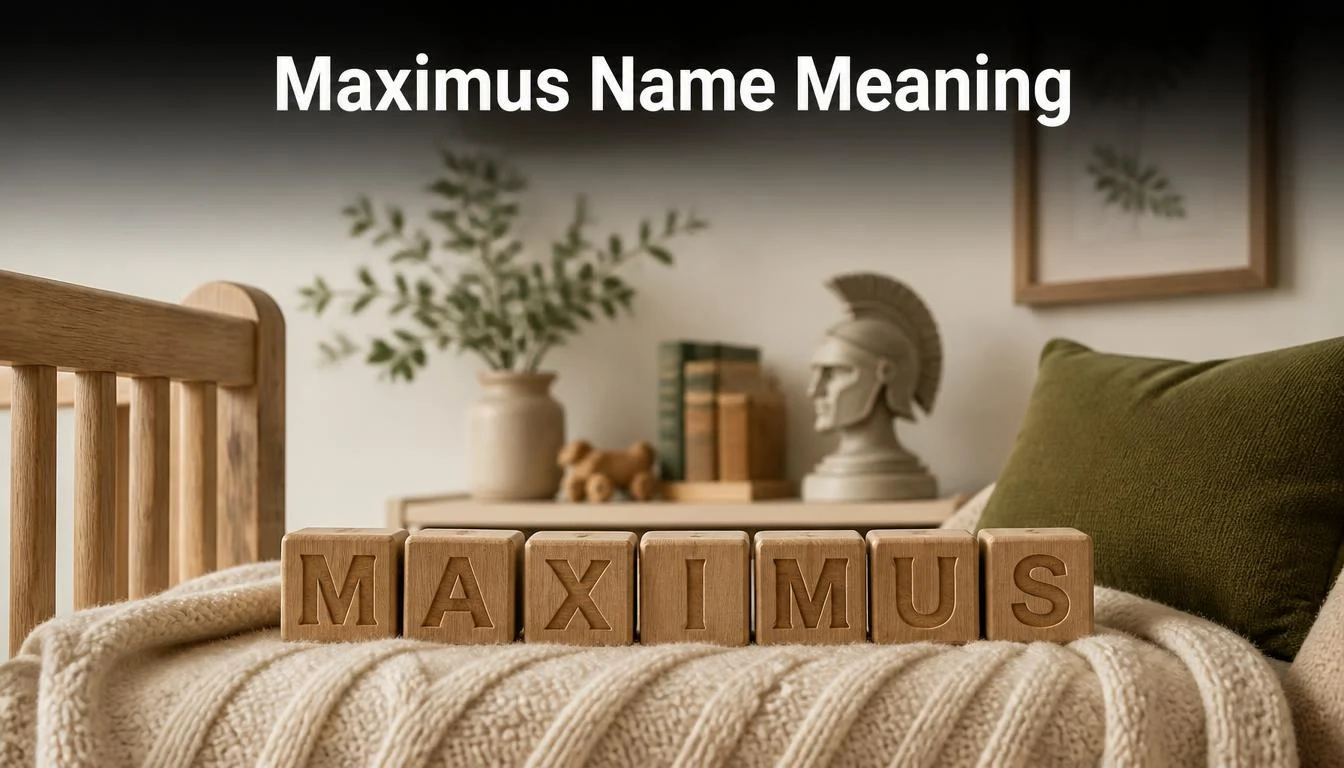
The Maximus name meaning comes from the Latin word maximus, meaning “greatest” or “largest.” Ancient Romans used it as a name and title that conveyed distinction, rank, and greatness. Maximus traditionally serves as a masculine name, and parents often choose it for its bold sound, classical history, and confident style.
The Maximus name meaning is commonly translated as “greatest” in Latin, giving this distinctive boy’s name a strong and confident appeal. Rooted in ancient Roman language and naming traditions, Maximus has a long history that connects it with strength, ambition, and distinction. Its bold sound and meaningful origin make it an appealing choice for parents looking for a name that feels both powerful and timeless.
Maximus also offers a blend of historical character and modern style. Its association with ancient Rome and its recognition in popular culture have helped maintain interest in the name across generations. Parents can choose familiar nicknames such as Max while keeping Maximus as the full name for a more formal feel. Whether you appreciate its Latin heritage, memorable pronunciation, or powerful meaning, Maximus offers plenty to explore when choosing a meaningful name for your baby.
Maximus at a Glance (Key Facts Table)
| Key Fact | Details |
|---|---|
| Gender | Traditionally masculine |
| Meaning | Greatest, largest |
| Origin | Latin |
| Pronunciation | MAK-suh-muhs |
| IPA | /ˈmæk.sɪ.məs/ (English pronunciation varies) |
| Syllables | 3 |
| Style | Classical, bold, strong |
| Popularity Level | Recognized and used in modern English-speaking countries |
| Numerology Number | 6 (Pythagorean numerology) |
| Lucky Color | Blue (traditional numerology association; not a verified fact) |
| Lucky Stone | Sapphire (symbolic association, not a historical rule) |
| Nicknames | Max, Maxi, Maxie, Mack |
| Name Length | 7 letters |
What Is Maximus?
Some names sound gentle and understated, while others immediately suggest strength and confidence. Maximus belongs to the second group. With its commanding rhythm and ancient Roman roots, the name feels grand without losing the familiar charm of its shorter form, Max.
Parents who like historical names often appreciate Maximus because it combines a meaningful Latin word with a style that still works in contemporary life. It can suit a family that prefers traditional names, enjoys classical history, or wants a longer formal name with an easy everyday nickname.
The name also carries a sense of ambition through its literal meaning, “greatest.” Although a name cannot determine a child’s personality or future, Maximus gives parents a meaningful starting point for expressing their hopes for a confident, thoughtful, and capable child.
Maximus Meaning
Maximus literally means “greatest” or “largest” in Latin. It represents the superlative form of magnus, which means “great” or “large.” Because of this connection, the name can suggest excellence, distinction, importance, and impressive stature.
In ancient Roman society, the word appeared in personal names and official titles. One famous example is Pontifex Maximus, the title of Rome’s chief priest. The word therefore carries historical associations with leadership, authority, and high rank, although its basic meaning remains straightforward.
Today, many parents interpret Maximus as a name that expresses strength, ambition, and self-confidence. These qualities reflect modern impressions of the name rather than guaranteed personality traits. Its meaning also offers a positive message: greatness can come from kindness, courage, integrity, and the effort someone puts into everyday life.
Origin and Etymology
Maximus comes from Latin, the language of ancient Rome. Its linguistic history follows this straightforward path:
Latin magnus (“great” or “large”) → Latin superlative maximus (“greatest” or “largest”) → the personal name Maximus.
Roman naming practices helped establish Maximus as a recognizable personal name. It appeared in the Roman world as a cognomen, a name element that could distinguish a family branch or an individual. Over time, the name also developed religious, historical, and cultural associations.
The related name Maxim appears in several European languages, while Maximo is used in Spanish and other Romance-language contexts. Max provides a shorter form that feels natural in English and many other languages.
History and Cultural Background
Maximus has a long history that reaches back to ancient Rome. Romans used the term to express greatness and distinction, and it appeared in personal names carried by military leaders, politicians, and other prominent figures. The name’s formal sound suited a society where family identity, public reputation, and civic position often mattered greatly.
One notable historical bearer was Quintus Fabius Maximus Verrucosus, a Roman statesman and military commander known for delaying tactics against Hannibal during the Second Punic War. His surname, Maximus, became closely associated with Roman history.
Another significant figure was Magnus Maximus, a Roman emperor who ruled in the western empire from 383 to 388 CE. His name connects Maximus with late Roman political history and later Welsh traditions, where he became known as Macsen Wledig.
As Latin influenced European languages, Maximus continued through historical records, religious traditions, and naming practices. In modern times, the name has gained visibility through films, books, and the growing appeal of classical baby names.
Religious or Spiritual Significance
Maximus is not originally a biblical Hebrew name or a name derived from the Quran. Its roots lie in Latin, and its primary meaning is “greatest” or “largest.” However, the name has religious associations through historical Christian figures, including Maximus the Confessor, a seventh-century Christian theologian known for his writings on Christian doctrine.
Several saints and church leaders also carried forms of Maximus. These connections make the name meaningful to some Christian families, but they do not change its Latin etymology. Parents who want a name with historical Christian associations may appreciate this background, while those seeking a specifically biblical name should understand that Maximus does not appear as a biblical character’s name.
Popularity and Trends
Maximus has become a recognizable choice for parents who like strong, classical names but want an alternative to shorter favorites such as Max. Its popularity has changed over time, with modern entertainment and renewed interest in Roman-inspired names contributing to its visibility.
- United States: US Social Security Administration data for 2025 placed Maximus around the top 300 boys’ names. Nameberry’s published SSA-based figures list it at number 276 for boys in 2025, following a lower ranking in 2024. The name reached a higher point during the 2010s before fluctuating in subsequent years.
- England and Wales: Data attributed to the Office for National Statistics placed Maximus at number 219 for boys in 2025, with 228 registrations. The figures suggest that it remains an established choice without dominating the most popular names.
- Other regions: Maximus also appears in international naming contexts, especially where Latin-derived names are familiar. Exact rankings vary by country, and comparable current statistics are not available for every region.
Over the past two decades, Maximus has moved from a relatively uncommon choice toward greater recognition. Its popularity has not followed a perfectly steady upward path. Parents should check the latest national records if they want to know its exact ranking in a particular country.
How Maximus Is Used Around the World
United States: Maximus is typically pronounced “MAK-suh-muhs” or “MAK-sih-muhs.” Many families use Max as an everyday name.
United Kingdom: The name fits comfortably alongside traditional Latin derived names. English speakers generally use a pronunciation similar to the American version.
South Asia: Maximus may appeal to families looking for an internationally recognizable name. Pronunciation can vary with local accents, and Max often serves as the simpler short form.
Europe: Latin-derived naming traditions make Maximus familiar in historical and cultural contexts. Local pronunciation varies, while related forms such as Maxim and Massimo may feel more natural in particular languages.
Spanish-speaking regions: Máximo is a related Spanish form. It shares the same underlying Latin root, although its spelling and pronunciation differ from Maximus.
Personality Traits Associated with Maximus
A name cannot predict character, intelligence, or future success. Still, the meaning and sound of Maximus can inspire certain traditional associations.
- Confidence: Its strong sound can create an impression of self-assurance.
- Leadership: Its Roman history connects it with authority and public distinction.
- Ambition: The meaning “greatest” can symbolize a desire to achieve meaningful goals.
- Courage: Its historical and cinematic associations may evoke bravery.
- Determination: The name can suggest persistence and commitment.
- Individuality: Its longer form stands apart from the more familiar Max.
These are cultural impressions rather than scientifically established personality traits. A child’s experiences, values, and relationships will shape their character far more than their name.
Numerology of Maximus
In Pythagorean numerology, each letter receives a number from 1 to 9. The resulting total is reduced to a single digit, unless a numerology tradition treats a particular result as a special number.
Using the standard letter values:
| Letter | Number |
|---|---|
| M | 4 |
| A | 1 |
| X | 6 |
| I | 9 |
| M | 4 |
| U | 3 |
| S | 1 |
| Total | 28 |
The calculation is 4+1+6+9+4+3+1=28, followed by 2+8=10, then 1+0=1.
Maximus has a numerology number of 1, not 6 as shown in the earlier glance table. In numerology traditions, number 1 represents independence, initiative, originality, and leadership. Numerology is a symbolic belief system, not a scientific method for predicting a child’s personality or future.
Blue is sometimes used as a symbolic color associated with calmness and confidence, while sapphire can represent wisdom or clarity in popular birthstone-style interpretations. Neither is an established lucky color or stone specifically linked to Maximus.
Nicknames and Short Forms
Maximus offers several nickname options, from familiar everyday choices to playful family names.
Cute nicknames
- Maxi: sweet and friendly.
- Maxie: a playful spelling for close family use.
- M: a simple initial-based nickname.
Casual nicknames
- Max: the most natural and widely recognizable short form.
- Mack: a punchy alternative with a similar opening sound.
- Maxy: an informal variation of Maxi.
Formal or distinctive options
- Max: works well in school, professional settings, and everyday conversation.
- Maximus: the full name for official records and more formal introductions.
- Mus: a less common family nickname inspired by the ending.
Variants and Spellings in Other Languages
| Form | Language | Notes |
|---|---|---|
| Maximus | Latin | Original Latin form meaning “greatest.” |
| Maximo | Spanish-influenced usage | Often written Máximo in Spanish, with an accent. |
| Maxim | Several European languages | A related form used in Slavic and other European naming traditions. |
| Maxime | French | A French masculine given name with Latin roots. |
| Massimo | Italian | An Italian form derived from the same Latin root. |
| Maximos | Greek | A Greek form associated with the same name tradition. |
| Maksim | Russian and other Slavic languages | A transliterated form of a widely used related name. |
| Macsen | Welsh | A Welsh form associated with the historical figure Magnus Maximus. |
These forms share historical or linguistic connections, but they do not all have identical pronunciation or cultural usage.
Famous People Named Maximus
The name appears in Roman history, Christian scholarship, and European intellectual traditions. Some notable bearers include:
- Quintus Fabius Maximus Verrucosus: Roman statesman and military commander known for his strategy against Hannibal.
- Magnus Maximus: Roman emperor who ruled the western empire from 383 to 388 CE.
- Petronius Maximus: Western Roman emperor who ruled briefly in 455 CE.
- Maximus the Confessor: Byzantine Christian monk and theologian known for his writings on Christian doctrine.
- Maximus of Turin: Early Christian bishop and religious writer.
- Maximus Planudes: Byzantine scholar and translator who worked with Greek and Latin texts.
- Maximus the Greek: Greek monk and scholar who contributed to religious and literary learning in Russia.
These historical figures demonstrate the name’s longstanding presence in political, religious, and scholarly contexts. They should not be confused with modern celebrities who use Max as a nickname rather than Maximus as their full name.
Fictional Characters and Pop Culture
One of the most recognizable modern associations comes from the 2000 film Gladiator. Russell Crowe plays Maximus Decimus Meridius, a fictional Roman general whose story centers on loyalty, loss, courage, and revenge. The character helped give Maximus a dramatic, heroic image for many contemporary audiences.
The name also appears in other fictional settings and literary works. However, the Gladiator character remains the clearest mainstream pop-culture reference for many people considering the name.
This association can be an advantage for parents who appreciate historical drama. On the other hand, some people may immediately connect the name with the film, so it is worth considering whether that association appeals to you.
Middle Names That Pair Well
Maximus is a long, emphatic first name, so shorter middle names often create a balanced full name. Traditional, nature-inspired, and modern choices can all work well.
| Middle Name | Full Name Example | Vibe |
|---|---|---|
| James | Maximus James | Classic and grounded |
| Alexander | Maximus Alexander | Regal and traditional |
| Jude | Maximus Jude | Short and contemporary |
| Oliver | Maximus Oliver | Warm and familiar |
| Henry | Maximus Henry | Timeless and polished |
| Cole | Maximus Cole | Modern and crisp |
| Elias | Maximus Elias | Gentle and meaningful |
| Leo | Maximus Leo | Bold and energetic |
| Gabriel | Maximus Gabriel | Traditional and melodic |
| Rowan | Maximus Rowan | Nature-inspired and relaxed |
Say each combination aloud with your surname. Rhythm, repeated sounds, and the initials will help you decide which pairing feels most natural.
Sibling Name Ideas
If Maximus is your preferred first name, these sibling names offer a similar balance of strength, history, and modern appeal.
Brother names
- August: Shares a classical Roman feel.
- Sebastian: Offers a long, elegant sound.
- Alexander: Carries historical weight and a familiar nickname.
- Theodore: Combines traditional roots with the friendly nickname Theo.
- Roman: Has a direct historical connection to ancient Rome.
Sister names
- Victoria: Shares a confident, classical style.
- Aurora: Brings a lyrical sound and an ancient Roman connection.
- Juliana: Offers an elegant name with Latin roots.
- Valentina: Feels expressive and romantic.
- Clara: Balances Maximus with a shorter, timeless name.
These combinations are suggestions rather than strict naming rules. Matching the overall style matters more than making every sibling’s name share the same origin.
Surnames That Pair Well and Initials Check
Maximus generally works well with short or medium-length surnames because its three syllables already give the full name a substantial rhythm.
Examples include:
- Maximus Reed: compact and confident.
- Maximus Bennett: balanced and traditional.
- Maximus Carter: clear and contemporary.
- Maximus Brooks: strong and straightforward.
- Maximus Sullivan: flowing and distinctive.
Before making a final choice, say the full name aloud and check how the first, middle, and last names sound together. Review the initials for unintended words or awkward abbreviations. Also consider whether the name is easy to spell over the phone and whether the child will enjoy using it in everyday situations.
Similar Names You May Like
- Max: A short, familiar form with the same root.
- Maxim: A related European name with a compact sound.
- Maximo: A Latin-derived alternative with Spanish-language appeal.
- Augustus: A classical Roman name associated with dignity and authority.
- Roman: A bold name connected with Roman heritage.
- Marcus: A traditional Roman name with a strong, familiar sound.
- Magnus: A name of Latin origin meaning “great.”
- Alexander: A widely used classic with a powerful sound.
- Cassius: A distinctive name with an ancient Roman connection.
- Atticus: A literary and classical choice with a polished style.
These alternatives suit different preferences, from a short everyday name to a distinctive choice with historical depth.
Pros and Cons of Choosing Maximus
Pros
- Meaningful definition: “Greatest” gives the name a positive, memorable meaning.
- Historical depth: Its Latin roots connect it with ancient Roman history.
- Flexible nickname: Max provides a simple everyday alternative.
- Distinctive sound: The full name feels bold and recognizable.
- International familiarity: Related forms appear across several languages and cultures.
Cons
- Longer spelling: Seven letters may take longer for young children to learn to write.
- Pronunciation differences: Some speakers emphasize the middle syllable differently.
- Strong impression: Its grand sound may feel too formal for parents who prefer understated names.
- Pop-culture association: Some people may think of Gladiator immediately.
- Nickname preference: A child may prefer Max over the full name, especially in casual settings.
Is Maximus Right for Your Baby?
Choose it if you want:
- A masculine name with a clear Latin meaning.
- A classic name that still feels distinctive.
- A strong historical connection without needing a biblical origin.
- An easy nickname such as Max.
- A name that pairs well with traditional or modern middle names.
Think twice if:
- You prefer very short names.
- You want a name that rarely attracts attention.
- You dislike grand or dramatic-sounding names.
- You want a name with a specific religious origin that Maximus does not have.
The best test is simple: imagine calling Maximus across a playground, introducing him as an adult, and seeing the full name on a formal document. If it feels natural in all three settings, it may be a good fit.
Maximus as a Surname or Place Name
Maximus is primarily relevant to baby-name searches as a Latin personal name, but the word also appears in historical titles and place names. The phrase Pontifex Maximus, for example, referred to the chief priest in ancient Roman religion and later became associated with the papacy.
The name also appears in the famous Roman venue Circus Maximus, an ancient chariot-racing stadium in Rome. In this context, maximus retains its Latin meaning rather than functioning as a baby’s name.
If you encounter Maximus in a history article, film, or location guide, use the surrounding context to distinguish the personal name from the Latin word or historical reference.
FAQs
What does the name Maximus mean?
Maximus means “greatest” or “largest” in Latin. The word developed from magnus, meaning “great” or “large.” Parents often interpret this meaning as a symbol of ambition, confidence, and excellence, although a name does not determine a person’s character or achievements.
Is Maximus a boy’s name or a girl’s name?
Maximus is traditionally a masculine given name. Some families may use it differently, but its established naming history is predominantly masculine. Parents who like the sound but prefer a shorter or more flexible option might also consider Max, while remembering that usage varies between cultures.
Is Maximus a biblical name?
No. Maximus does not originate in the Bible; it comes from Latin. However, several Christian historical figures, including Maximus the Confessor, carried the name. These connections give it Christian historical significance without making it the name of a biblical character.
How do you pronounce Maximus?
English speakers commonly pronounce Maximus as “MAK-suh-muhs” or “MAK-sih-muhs.” Regional accents can affect the middle vowel. The name has three syllables, and Max is a convenient short form if a family prefers something quicker for everyday conversation.
What is the origin of Maximus?
Maximus comes from Latin, the language of ancient Rome. It originally functioned as a word meaning “greatest” or “largest” and appeared in Roman names and titles. Its later use across European history helped preserve it as a personal name.
What are the best nicknames for Maximus?
Max is the most straightforward nickname for Maximus. Other possibilities include Maxi, Maxie, Maxy, Mack, and M. Families can choose a nickname based on the child’s personality and their own preferences, or simply use the full name in daily life.
Is Maximus a popular baby name in 2026?
The latest annual data available for this article covers births in 2025. US SSA-based rankings place Maximus around the top 300 boys’ names, while England and Wales recorded 228 boys with the name in 2025. Rankings may change when new annual data becomes available.
What names pair well with Maximus?
Short middle names such as James, Jude, Leo, and Cole can balance Maximus’s three syllables. For siblings, names such as Roman, August, Victoria, and Clara share a classical or timeless style without sounding too similar.
Does Maximus have a religious meaning?
Its literal meaning is Latin rather than specifically religious. However, Christian saints and theologians used the name, creating a historical religious association. Families may appreciate that background, but the name itself does not translate to a specifically Christian or Islamic concept.
What is the numerology number of Maximus?
Using the standard Pythagorean numerology system, Maximus reduces to the number 1: its letters total 28, which becomes 10 and then 1. Numerology traditions associate this number with independence and initiative, but these interpretations are symbolic beliefs rather than scientific findings.
Conclusion
The Maximus name meaning, “greatest,” combines a powerful definition with a long history rooted in ancient Rome. Its classical origin, distinctive sound, and easy nickname Max make it an appealing option for parents who want a name with character and substance. Although its dramatic style may not suit every family, Maximus offers a memorable balance of tradition and modern appeal. Explore related names such as Max, Magnus, Roman, and Augustus to find the name that feels right for your family.
Read More Articles
- Amaya Name Meaning | Origin, History, Popularity and Symbolism In 2026
- Teagan Name Meaning | Origin, History, Popularity and Symbolism In 2026










