Quick Answer
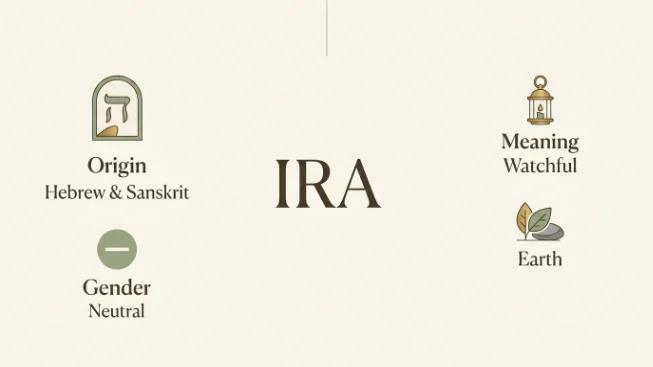
Ira is a genuinely unisex name with more than one root. As a Hebrew boy’s name it means “watchful,” while as a Russian girl’s name it is a short form of Irina or Irene, meaning “peace.
“The Ira name meaning is connected with different linguistic and cultural traditions, giving this short name a rich and interesting background. Depending on its origin, Ira can carry different meanings and associations, making it a versatile choice for parents looking for a name that is simple, distinctive, and meaningful. Its brief spelling and easy pronunciation also give it a timeless quality that works well across different cultures.
Beyond its meaning, Ira has a history that adds depth to its appeal. In this guide, we’ll explore the Ira name meaning, origin, history, pronunciation, popularity, and cultural significance so you can better understand what makes Ira such a memorable name.
Key Facts Box
| Fact | Detail |
|---|---|
| Gender | Unisex (used for children) |
| Meaning | “Watchful” (Hebrew, boy) / “Peace” (Russian, girl) |
| Origin | Hebrew, Russian, Sanskrit |
| Pronunciation | EYE-rah (US) or EE rah (Russian/European) |
| Religious Link | Old Testament priest to King David |
What Is Ira?
Ira is a short given name recognized across several unrelated language traditions, which is part of what makes it distinctive. It is not a single name with one clear history, the way many classic names are. Instead, it functions almost like three separate names that happen to share the same spelling and sound: a Hebrew masculine name, a Russian feminine name, and a Sanskrit name used by people of different genders, with different meanings depending on who carries it.
This layered background is why Ira is correctly described as unisex rather than strictly male or strictly female. In the United States, historical records show it was used almost exclusively as a boy’s name well into the 20th century, but its Russian and international use as a girl’s name has become increasingly familiar, especially as a nickname.
Hebrew Origin: “Watchful” or “Roused”
The most historically documented meaning of Ira comes from Hebrew, where the name is understood to mean “watchful” or “roused,” derived from a Hebrew root associated with alertness and attentiveness. This is the meaning tied to the name’s appearance in the Old Testament.
Russian, Belarusian, and Ukrainian Meaning: “Peace”
In Russian, Belarusian, and Ukrainian naming traditions, Ira functions differently. Here, it is not an independent name with its own root meaning, but rather a diminutive, or affectionate short form, of Irina, which in turn traces back to the Greek name Irene, meaning “peace.” When Ira is used this way, its meaning is best understood as “peace,” inherited directly from Irene rather than from any separate Slavic root.
Sanskrit Meaning: “Wind,” “Air,” or “Earth”
Sanskrit tradition adds a third, distinct meaning. As a masculine Sanskrit name, Ira has been associated with Vayu, the Hindu wind god, giving it a meaning close to “wind” or “air.” As a feminine Sanskrit name, Ira instead means “the earth,” and is connected to a figure in Hindu tradition described as a daughter of Daksha and a mother associated with plants and vegetation.
Why Ira Has Multiple Meanings
Because these three traditions developed independently, there is no single “correct” meaning of Ira in the way there might be for a name with one clear linguistic root. The accurate meaning depends entirely on which origin and gender context is being referenced.
Ira as a Rare Cross-Cultural Name
This is worth pausing on because it is genuinely uncommon. Most short given names, even ones used across multiple countries, trace back to one linguistic family that simply spread and adapted over time. Ira is different: the Hebrew, Russian, and Sanskrit uses did not branch from a shared root and then drift apart. They arose independently, in unrelated language families, and simply arrived at the same short, easy-to-pronounce sound. Name researchers sometimes describe this kind of pattern as convergent naming, where separate cultures land on the same result without any direct historical link between them.
Origin and Etymology
Hebrew Origin of Ira
The Hebrew origin of Ira is the most historically anchored of the three. It appears directly in the Old Testament, where Ira is named as a priest during the reign of King David, one of several officials mentioned briefly in the biblical text. This gives the name a documented, ancient textual origin, even though it never became one of the most frequently used biblical names in later Jewish or Christian naming traditions.
Russian and Slavic Usage
The Russian usage follows a different linguistic path entirely. Irina, the full name from which Ira is shortened, descends from the Greek Eirene, meaning “peace,” a name also carried by the Greek personification of peace in classical mythology. Ira, in this context, is not an independently rooted name but a natural, affectionate contraction that developed the way many short forms do in Slavic naming culture, similar to how Sasha functions as a short form of Alexander or Alexandra.
Sanskrit Origin and Meaning
The Sanskrit origin developed separately from both of the above, rooted in classical Hindu religious texts rather than biblical or Greek tradition. Because Sanskrit assigns different meanings to the same spelling depending on gender, in relation to Vayu for males and to the earth for females, this branch of the name’s history stands apart from both the Hebrew and Russian traditions.
Separate Origins of the Name Ira
It is worth being direct about one thing: despite occasional casual claims online, there is no verified linguistic connection between these three origins. Ira is best understood as a case of convergent naming, where separate cultures independently produced a short, similar-sounding name, rather than one origin branching into the others.
History and Cultural Context
Ira in American Naming History
In English-speaking countries, Ira had a distinct historical moment. Naming records show that from roughly 1880 to 1895, Ira comfortably sat within the top 100 boys’ names in the United States, reflecting a broader 19th-century trend of using short, biblically rooted names. Its popularity as a girls’ name during the same general era, while smaller, kept it listed among the top 1000 girls’ names until the 1940s, showing that even in this period, the name was not used strictly for one gender.
Ira and Early American History
Historically, Ira also carries a notable connection to early American history through Ira Allen, a founding figure of the Republic of Vermont and younger brother of Ethan Allen, who helped design the Great Seal of Vermont. While not a household name today, this association gave Ira a genuine foothold in 18th-century New England naming culture.
Ira in Russian, Ukrainian, and Belarusian Culture
In Russian, Ukrainian, and Belarusian communities, Ira’s cultural role has always been different: less a formal given name in its own right and more a warm, everyday nickname, used constantly in casual and family settings for anyone formally named Irina.
Ira in South Asian Culture
In South Asian communities influenced by Sanskrit naming traditions, Ira appears in religious and cultural texts rather than everyday secular naming records, giving it a more textual, symbolic presence tied closely to Hindu mythology.
Three Separate Cultural Histories
These three histories rarely overlapped in practice. A 19th-century American family choosing Ira for a son was almost certainly drawing on its biblical association, likely without any awareness of its Sanskrit meaning. A Russian speaking household calling a daughter Ira was simply using an everyday nickname for Irina, with no connection to the Old Testament at all. Understanding Ira’s cultural context, then, means recognizing that the name has lived several separate lives in parallel, rather than following one continuous historical thread from a single starting point.
Examples
Here are a few natural, real-world ways the name Ira appears in everyday life:
- “Ira introduced himself as the new team lead this morning.”
- “Her grandmother’s name was Irina, but everyone just called her Ira.”
- “The professor referenced Ira, the priest mentioned briefly in the Old Testament.”
- “Ira and her sister both have short, two-syllable names.”
- “In the Vermont history exhibit, Ira Allen’s portrait hangs near the entrance.”
These examples reflect how naturally the name moves between contexts, professional, familial, historical, and religious, without needing further explanation in any of them.
Variants and Spellings
Because Ira draws from three unrelated traditions, its “variants” differ depending on which origin is being followed.
- Irina the full Russian form from which the feminine Ira is shortened
- Irene the Greek root name behind Irina, sharing the “peace” meaning
- Iras a Greek variation sometimes linked to Ira in name reference sources
- Eira a Welsh feminine name, meaning “snow,” occasionally grouped with Ira for its similar sound, though it is a separate name with its own distinct origin
- Iraia a Basque name meaning “fern,” sometimes listed alongside Ira for phonetic similarity rather than shared etymology
It is worth noting that Eira and Iraia are not true linguistic variants of Ira; they simply sound similar and are often grouped together in general name-list websites.
Famous People Named Ira
A number of real, well known individuals have carried the name Ira across different fields:
- Ira Gershwin American lyricist, known for his decades-long songwriting partnership with composer George Gershwin
- Ira Glass American radio personality, host and producer of the long-running program This American Life
- Ira Allen 18th-century founding figure of the Republic of Vermont and co-designer of the Great Seal of Vermont
- Ira Aldridge 19th-century Shakespearean actor, widely recognized as one of the first Black actors to achieve major success on European stages
Ira vs. Related Terms
| Term | Meaning | How It Differs |
|---|---|---|
| Ira | “Watchful” (Hebrew, boy) or “peace” (Russian, girl) | The core name itself, unisex across two unrelated traditions |
| Irina | Full Russian name meaning “peace” | The complete name that Ira shortens to in Slavic use |
| Irene | Greek name meaning “peace” | The original Greek root behind Irina, used directly in English |
| Era | An English word referring to a period of time | Sounds similar to Ira but is unrelated linguistically |
Common Mistakes People Make
One common mistake is assuming Ira has one single meaning. Because the name is genuinely unisex across unrelated traditions, stating a single definition without specifying gender and origin gives an incomplete picture.
Another frequent error is confusing Ira with Era, an English word referring to a stretch of time. Despite the similar sound, the two are not linguistically connected in any documented way.
Some also assume Ira is simply a modern invented nickname. In reality, its Hebrew form is a documented biblical name in its own right, not a shortened version of anything else, which distinguishes it from its separate Russian usage as a diminutive of Irina.
In the United States, historical naming records show Ira was used far more often for boys than girls during its 19th-century peak, and only later did its use as a girl’s nickname become more visible internationally. Unisex status, in other words, is often the result of two separate naming histories running side by side, not evidence that a name was always gender-neutral from the start.
Word Origin / Etymology Recap
To summarize the linguistic picture: Ira reaches English speaking naming culture through at least three independent paths. The Hebrew form, meaning “watchful,” comes directly from the Old Testament. The Russian form, meaning “peace,” is a short form of Irina, which itself descends from the Greek Irene. The Sanskrit form carries yet another meaning entirely, tied to Vayu for boys and to the earth for girls. These origins developed separately, with no verified historical link connecting them.
Why the Name Has Endured
Part of what has kept Ira in steady, if modest, use across generations is exactly what makes it complicated to define: its short length and soft sound make it easy to adopt across very different naming cultures, from Hebrew scripture to Russian family nicknames to Sanskrit religious texts. A name that can comfortably serve as a formal Old Testament name, a warm Slavic nickname, and a symbolic Sanskrit term all at once has a kind of built in flexibility that few single-origin names share, which likely explains its long, quiet persistence rather than any single dramatic wave of popularity. Its recent modest resurgence in the United States also fits a broader pattern seen with many short, vintage names: parents drawn to brevity and a slightly old-fashioned, understated feel have been revisiting names like Ira the same way they have revisited other short, once-common names from the late 19th century.
Easy Memory Tricks
A simple way to remember the dual meaning is to link each origin to a feeling: Hebrew Ira, “watchful,” pairs naturally with the image of a guard standing alert, while Russian Ira, tied to Irina and “peace,” pairs with a calmer, softer image. Keeping those two mental pictures separate makes it easier to recall which meaning applies in which context.
FAQs
What does the name Ira mean?
It depends on origin: in Hebrew, Ira means “watchful”; in Russian, it is a short form of Irina, meaning “peace.”
Is Ira a boy or girl name?
Ira is genuinely unisex. It has been used historically as a boy’s name in Hebrew and English-speaking traditions, and as a girl’s name in Russian-speaking cultures.
Where does the name Ira come from?
It has three separate origins: Hebrew, Russian (as a short form of Irina), and Sanskrit.
Is Ira a biblical name?
Yes. In the Old Testament, Ira is named as a priest during the reign of King David.
Is Ira related to the name Irina?
Yes, but only in Russian and related Slavic traditions, where Ira is used as an affectionate short form of Irina.
Is Ira the same as the word “era”?
No. Despite the similar sound, Ira and the English word “era” are unrelated in origin and meaning
What is the Sanskrit meaning of Ira?
In Sanskrit, Ira means “wind” for boys, linked to the god Vayu, and “the earth” for girls, linked to a maternal figure in Hindu tradition.
Conclusion
Ira stands out among given names for having not one origin story, but several, each carrying its own distinct meaning and cultural weight. Whether traced to the watchful priest of the Old Testament, the peaceful warmth of a Russian nickname for Irina, or the elemental symbolism of Sanskrit tradition, the ira name meaning ultimately depends on which cultural thread is being followed. That very layering is what gives this short, simple name its quiet, lasting appeal across such different corners of the world.










