Quick Answer
Mason means “stoneworker,” an English occupational surname that now ranks among the most popular boy names in the United States.
The Mason name meaning has a strong connection to craftsmanship, skill, and tradition. The name comes from an occupational surname associated with a person who worked as a stone mason or builder. Over time, Mason developed from a family name into a widely used given name, bringing with it a sense of strength, practicality, and skilled workmanship. Its straightforward sound and solid historical roots have helped it remain a popular choice for parents.
Beyond its occupational origin, Mason has a modern appeal that feels both familiar and distinctive. The name carries an enduring connection to building and creating, making it a meaningful choice for families who appreciate names with a clear historical story. In this guide, we’ll explore the Mason name meaning, its origin and history, pronunciation, popularity, cultural associations, personality ideas, and other interesting facts that help explain why Mason continues to attract attention.
Key Facts Box
| Fact | Detail |
|---|---|
| Gender | Boy |
| Meaning | “Stoneworker” or “one who builds with stone” |
| Origin | Old French/English, occupational surname |
| Pronunciation | MAY-sən |
| Related Concept | Occupational surnames |
What Is Mason?
Mason works as a masculine given name today, though it began life as a surname that identified a person’s trade. Craftsmen who cut, shaped, and laid stone for buildings and monuments carried this surname for generations before families adopted it as a first name.
Many occupational surnames share this same story. Smith, Baker, and Carpenter all followed a similar path from job title to family name to personal name. Mason stands out because stonework carried real prestige in medieval Europe, and that respected craft still colors the name’s modern appeal.
Mason Meaning
- Mason means “stoneworker” or “one who builds with stone.”
The word describes a skilled craftsman who cuts, shapes, and lays stone to construct buildings, walls, and monuments.
This occupational meaning stays remarkably clear compared to many older names. Mason doesn’t require decoding through layers of mythology or scripture it simply names a trade that people can picture immediately.
Parents today rarely choose Mason because they want to reference stonework directly. Instead, they respond to the name’s strong, modern sound. The occupational meaning still holds true, though, and it gives the name a grounded, tangible quality that many invented names lack.
Origin and Etymology
Mason traces back to the Old French word masson, which itself came from a Late Latin form referring to stoneworkers. English speakers borrowed this word after the Norman Conquest of 1066, when French vocabulary flooded into English across many trades and professions.
Stonemasons held an important place in medieval society. They built castles, cathedrals, and city walls, and their skilled labor demanded years of training through apprenticeship systems and guilds. Over time, this profession became so closely tied to certain families that “Mason” turned into a hereditary surname.
Linguists trace this etymology with confidence, since the occupational root leaves little room for dispute, unlike names built from older, less documented word combinations.
History and Cultural Context
Stonemasons shaped much of medieval Europe’s physical landscape. They built the great cathedrals, castles, and civic buildings that still stand today, and their craft carried genuine social respect within medieval guild systems.
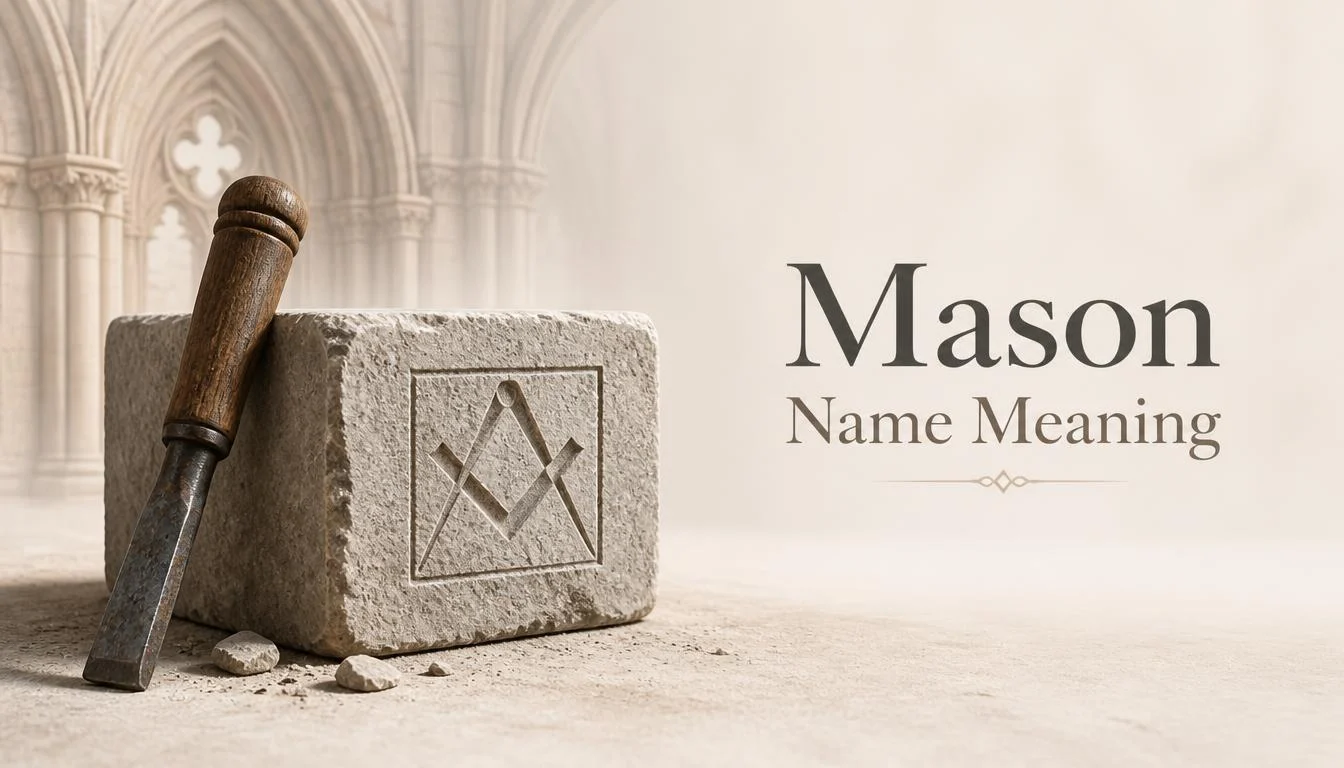
Freemasonry later borrowed symbolism and terminology from the stonemasons’ trade, adopting tools like the compass and square as fraternal symbols. This connection added another layer of cultural resonance to the surname over the centuries, even though most people who carry the name today have no direct tie to either stonemasonry or Freemasonry.
Mason crossed over from surname to popular first name during the late 20th and early 21st centuries. American parents drove much of this shift, favoring Mason alongside other occupational surnames turned first names, such as Cooper and Carter.
Examples
Seeing the name in everyday context helps show how naturally it fits modern usage:
- “They named their son Mason after his great-grandfather’s trade.”
- “Mason built an impressive block tower during playtime.”
- A birth announcement reads: “Welcome, Mason Elliott — born August 30th.”
- A school roster lists “Mason W.” among classmates with similarly modern names.
These examples show the name working comfortably across formal, personal, and everyday settings.
Variants and Spellings
Mason keeps a fairly stable spelling across regions, though a few genuine variants exist:
- Masen a modern stylistic spelling.
- Mayson another modern spelling variant.
- Massey a distantly related surname sharing similar roots, though families use it far less often as a first name.
Because Mason developed as a surname with a consistent spelling history, this list stays short rather than including forced or invented alternatives.
Famous People Named Mason
- Mason Mount English professional footballer who plays for Manchester United and the England national team.
- Mason Ramsey American country singer who gained viral fame for a yodeling performance in a Walmart store.
- Mason Gooding American actor known for film and television roles, son of actor Cuba Gooding Jr.
Mason vs. Related Terms
| Term | Meaning | How It Differs |
|---|---|---|
| Mason | “Stoneworker” | The occupational surname now widely used as a first name |
| Carter | “Cart driver” | A different occupational surname, unrelated to stonework |
| Cooper | “Barrel maker” | Another occupational surname with a similar naming pattern |
| Carpenter | “Woodworker” | A related trade name, though tied to wood rather than stone |
FAQs
What does the name Mason mean?
Mason means “stoneworker,” describing a skilled craftsman who built with stone in medieval Europe.
Is Mason a common name today?
Yes, Mason ranks among the most popular boy names in the United States, especially since the early 2000s.
Why did Mason become a first name?
Parents began adopting occupational surnames as first names during the late 20th century, and Mason’s strong, modern sound made it an easy favorite.
Is Mason connected to Freemasonry?
The Freemasons borrowed stonemason symbolism and terminology when they formed their fraternal organization, but the connection stays symbolic rather than genealogical for most people who carry the name today.
What is the female version of Mason?
No widely recognized traditional feminine form exists, though some parents use Mason as a unisex choice today.
How do you pronounce Mason?
Mason follows a two-syllable pattern: MAY-sən, with stress on the first syllable.
What are common nicknames for Mason?
Most families leave Mason unshortened, though “Mace” occasionally appears as an informal nickname.
Conclusion
Mason carries a clear, tangible meaning: “stoneworker,” rooted in medieval craft traditions and the Old French word masson. Its rise from a respected trade surname to one of today’s most popular boy names shows how naming trends can reshape a word’s entire role in everyday language. Whether parents choose it for its grounded meaning or its strong, contemporary sound, Mason continues to hold lasting appeal.
Read More Articles
- Wyatt Name Meaning | From Medieval Roots to a Modern Favorite In 2026
- Diana Name Meaning | Origin and the Story Behind This Classic Name In 2026











1 thought on “Mason Name Meaning | A Strong Name With a Skilled Heritage In 2026”