Quick Answer:
Penelope is a feminine name of Greek origin, traditionally associated with the meaning “weaver” or “duck.” It is best known from Penelope, the faithful wife of Odysseus in Homer’s Odyssey.
The name Penelope has a graceful, timeless quality that has helped it remain popular across generations. With roots in ancient Greek tradition and a strong connection to classical literature, Penelope carries a sense of loyalty, patience, intelligence, and enduring strength. The name is especially well known through Homer’s Odyssey, where Penelope is portrayed as the devoted and clever wife of Odysseus. Her story has given the name a lasting cultural identity that goes far beyond its ancient origins.
Today, Penelope feels both classic and modern, making it an appealing choice for parents looking for a name with history and character. Its elegant sound, literary association, and rich cultural background have contributed to its continued popularity. In this guide, we’ll explore the Penelope name meaning, Greek origin, historical background, pronunciation, nicknames, popularity, personality associations, and other interesting facts to help you understand the story behind this beautiful name.
Key Facts About Penelope
| Fact | Details |
|---|---|
| Gender | Girl |
| Meaning | Traditionally associated with “weaver”; also linked with “duck” |
| Origin | Ancient Greek |
| Pronunciation | puh-NEL-uh-pee |
| Greek Form | Πηνελόπη (Pēnelopē) |
| Famous Association | Penelope, wife of Odysseus in The Odyssey |
| Style | Classic, literary, elegant, timeless |
What Is the Name Penelope?
Penelope is a traditional feminine given name of Greek origin. It is most famously associated with the character Penelope in Homer’s Odyssey, where she is the wife of Odysseus and the mother of Telemachus.
The name has survived for centuries through Greek literature and European naming traditions. Although its precise ancient etymology is uncertain, Penelope has developed a strong cultural identity of its own because of its connection with one of classical literature’s best known female characters.
In modern English speaking usage, Penelope is generally recognized as a classic girl’s name with a literary and historical feel.
What Makes Penelope Different From Similar Names?
Penelope is distinctive because its identity comes not only from a linguistic meaning but also from a major literary character.
Unlike names whose meanings have a straightforward dictionary translation, Penelope’s history involves:
- Ancient Greek language
- Greek mythology
- Homer’s Odyssey
- Classical literature
- European naming traditions
- Modern English-language usage
This gives Penelope a particularly rich cultural background.
Penelope Name Meaning
The traditional explanations for the Penelope name meaning include “weaver” and “duck.” However, the etymology is not entirely settled.
Penelope Meaning “Weaver”
The association with “weaver” is especially strong because of Penelope’s famous story in The Odyssey.
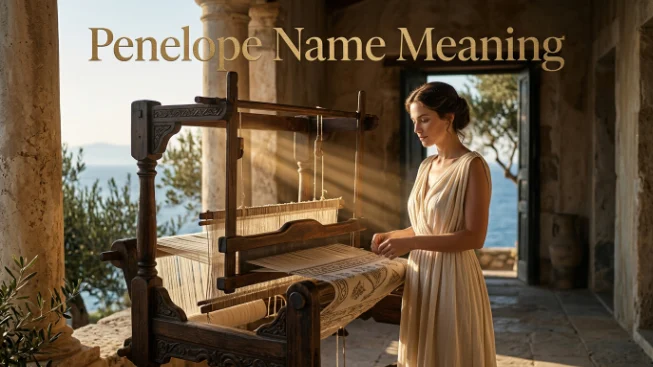
In the epic, Penelope uses weaving as part of a clever strategy to delay remarriage while waiting for Odysseus to return. She tells the suitors that she must finish weaving a burial shroud for Odysseus’s father before choosing a new husband.
She then secretly undoes the day’s weaving at night.
This makes weaving an important symbol of Penelope’s intelligence, patience, and determination. Because of this story, modern interpretations of her name frequently connect Penelope with the idea of a weaver.
However, it is important to distinguish literary symbolism from confirmed etymology. The fact that Penelope is famously associated with weaving does not necessarily prove that the ancient Greek name originally meant “weaver.”
Penelope Meaning “Duck”
Another traditional explanation connects Penelope with a Greek word referring to a duck, sometimes specifically interpreted as a type of duck.
This interpretation appears in discussions of the ancient Greek form of the name, but scholars have not established the original derivation with complete certainty.
Therefore, it is better to describe “duck” as a traditional proposed etymological association, rather than claiming it is unquestionably the name’s original meaning.
Symbolic Meaning of Penelope
Because of the literary character, Penelope is often symbolically associated with:
- Loyalty
- Patience
- Wisdom
- Faithfulness
- Intelligence
- Perseverance
- Resourcefulness
- Devotion
These qualities are connected primarily with the character in The Odyssey, rather than being literal dictionary meanings of the name.
Origin and Etymology of Penelope
Penelope comes from the ancient Greek form Πηνελόπη, transliterated as Pēnelopē.
The exact etymology remains uncertain. Several explanations have been proposed over time, but none should be presented as an absolutely established origin.
Ancient Greek Roots
The name belongs to the world of ancient Greek language and literature. Its earliest fame comes from Homer’s Odyssey, an epic traditionally dated to the late eighth or early seventh century BCE.
Penelope’s importance in the poem helped preserve the name as a recognizable cultural name for generations.
Is Penelope Definitely Greek?
Yes, Penelope is generally classified as a Greek name, particularly an ancient Greek literary name. What remains uncertain is not its broad cultural origin but the precise linguistic explanation of the name itself.
This distinction matters:
Origin: Ancient Greek well established.
Exact original meaning: Uncertain or disputed.
Why Is the Etymology Uncertain?
Ancient personal names do not always have transparent origins. Some may come from words that changed meaning, dialect forms that disappeared, older languages, or naming traditions that were already established before surviving written records.
As a result, several proposed interpretations of Penelope exist, but modern readers should be cautious about treating one simple translation as definitively proven.
Penelope in Greek Mythology
Penelope is one of the central women in Homer’s Odyssey.
She is the wife of Odysseus, the Greek hero whose long journey home forms the central story of the epic. While Odysseus is away, Penelope remains in Ithaca with their son, Telemachus.
Penelope and Odysseus
Odysseus is absent for many years because of the Trojan War and his difficult journey home.
During this time, numerous suitors seek Penelope’s hand in marriage. She does not simply accept one of them. Instead, she uses intelligence and deception to postpone making a decision.
Her famous weaving trick becomes one of the most memorable episodes connected with her character.
The Weaving Trick
Penelope announces that she will choose a new husband after completing a burial shroud for Laertes, Odysseus’s father.
She weaves during the day but secretly unravels part of the work at night.
This allows her to delay the suitors for an extended period.
Eventually, her deception is discovered, but the episode establishes Penelope as a woman who relies on intelligence and strategy rather than physical power.
Penelope’s Character
Penelope is often remembered for her:
Faithfulness: She continues to hope for Odysseus’s return.
Intelligence: She repeatedly outsmarts the suitors.
Patience: She survives years of uncertainty.
Resourcefulness: She finds practical ways to protect herself and her household.
Emotional strength: She manages difficult circumstances while maintaining her position in Ithaca.
These characteristics are a major reason the name Penelope carries such strong cultural associations today.
The Historical and Cultural Significance of Penelope
Penelope’s importance extends beyond her name.
She became an influential literary figure because she represents a form of strength based on intelligence, patience, and strategic thinking.
Penelope in Classical Literature
Her story belongs to one of the foundational works of Western literature. The Odyssey has been translated, adapted, studied, and retold for centuries.
As a result, Penelope became more than simply a character’s name. She became a recognizable literary archetype.
Penelope as a Symbol of Loyalty
In many interpretations, Penelope represents loyalty to an absent spouse. Her story has therefore influenced later discussions of fidelity and devotion.
However, modern readers also frequently emphasize another side of her character: she is not passive.
Her ability to manipulate circumstances and challenge the expectations of the suitors demonstrates considerable agency and intelligence.
Penelope in Modern Culture
The name has remained visible in literature, television, film, and popular culture.
Its classical background gives it a scholarly and literary quality, while its pleasant sound has helped it transition naturally into modern naming.
How Do You Pronounce Penelope?
Penelope is commonly pronounced:
puh-NEL-uh-pee
The strongest emphasis is generally placed on the second syllable.
Pronunciation Breakdown
Pe → puh
nel → NEL
o → uh
pe → pee
Together:
puh-NEL-uh-pee
The pronunciation may vary slightly across languages and accents, but the four-syllable English pronunciation is widely recognizable.
Is Penelope a Biblical Name?
No. Penelope is not a biblical name.
Its origin is connected with ancient Greek language and literature, especially Homer’s Odyssey. It does not originate from the Hebrew Bible or Christian Bible.
However, its long historical use and association with classical literature give it an ancient cultural background.
This is an important distinction for parents researching traditional names: Penelope is ancient and literary, but it is not biblical in origin.
Is Penelope a Mythological Name?
Yes. Penelope is strongly associated with Greek mythology and epic literature.
She is the wife of Odysseus in Homer’s Odyssey. Although the Odyssey is generally categorized as epic literature rather than a modern mythology text, Penelope is firmly embedded in the mythology and legendary traditions surrounding ancient Greece.
Her story is one of the best-known narratives involving a woman in Greek epic.
Penelope Name Examples
Penelope works well as both a formal first name and a literary-inspired choice.
Example Full Names
Some combinations include:
- Penelope Grace
- Penelope Rose
- Penelope Jane
- Penelope Claire
- Penelope Marie
- Penelope Elise
- Penelope Anne
- Penelope Sophia
The name pairs especially well with shorter middle names because Penelope itself has four syllables.
Example Sentences
Here are natural examples using the name:
- “Penelope started school this year.”
- “We chose Penelope because we loved its classical history.”
- “Penelope is named after the famous character in The Odyssey.”
- “Her parents liked Penelope because it sounds both traditional and elegant.”
Variants and Spellings of Penelope
- Penelope has fewer direct spelling variants than some traditional names because the classical form has remained relatively stable.
Penelope
Penelope is the standard English spelling and the form most familiar internationally.
Pénélope
Pénélope is a French form, written with an accent over the first “e.”
Penelopa
Penelopa appears as a form of the name in some Slavic-language contexts.
Penelopi
Penelopi is a transliterated or adapted form that can occur in modern Greek contexts.
These forms should be viewed as language-specific adaptations rather than interchangeable English spellings.
Nicknames for Penelope
One advantage of Penelope is that it offers several natural nickname possibilities.
Common Penelope Nicknames
- Penny
- Pen
- Nell
- Nelly
- Nellie
- Poppy
- Lola
Not every nickname is historically derived directly from the name. Some develop through sound, syllable patterns, or family preference.
Penny is one of the most recognizable modern nicknames for Penelope.
Famous People Named Penelope
Several notable women have the name Penelope.
Penélope Cruz
Penélope Cruz is a Spanish actress known internationally for her work in Spanish-language and English-language cinema. She has received major acting honors and is one of the best-known modern bearers of the name.
Penelope Keith
Penelope Keith is an English actress and presenter known for British television and stage work. She became particularly recognized for sitcom roles and later presented television programs focused on British life and homes.
Penelope Spheeris
Penelope Spheeris is an American filmmaker and director known for works including Wayne’s World and the documentary trilogy The Decline of Western Civilization.
These examples demonstrate that Penelope has remained a recognizable name across acting, television, and filmmaking.
Penelope vs. Related Names
| Term | Meaning | How It Differs |
|---|---|---|
| Penelope | Traditionally associated with “weaver” or “duck” | Ancient Greek literary name |
| Pénélope | French form of Penelope | Uses French spelling with an accent |
| Penelopa | Language-specific form of Penelope | Used in some Slavic naming traditions |
| Penny | Common nickname for Penelope | Informal short form |
| Nell | Traditional nickname form | Shortened form that can be used for Penelope |
| Pen | Short nickname | Directly taken from the beginning of Penelope |
Penelope is distinctive because its strongest cultural identity comes from Greek epic literature, while names such as Penny and Nell function primarily as shorter everyday forms.
What Personality Traits Are Associated With Penelope?
A name does not scientifically determine personality. However, cultural associations with the Penelope of The Odyssey have influenced the qualities people often connect with the name.
Penelope is commonly associated symbolically with:
Intelligent
Her ability to delay the suitors through clever planning makes intelligence one of her strongest literary associations.
Patient
She waits for Odysseus for many years, making patience central to her story.
Loyal
Her relationship with Odysseus has made faithfulness an enduring association of the character.
Strong
Penelope’s strength is portrayed through endurance and strategic thinking rather than physical force.
Resourceful
Her weaving strategy demonstrates her ability to create solutions under difficult circumstances.
These are literary associations, not predictions about someone who carries the name.
Is Penelope a Good Name?
Penelope can be an excellent choice for parents who want a name with ancient roots, literary significance, feminine elegance, and strong cultural recognition.
Its main strengths include:
- Ancient Greek heritage
- A famous literary connection
- Multiple nickname options
- Easy recognition in English
- A timeless rather than trend-dependent character
- Strong associations with intelligence and perseverance
The only consideration some parents may have is its length and four-syllable pronunciation. If a shorter name is preferred, nicknames such as Penny or Nell provide more compact everyday options.
Why Is Penelope Considered an Elegant Name?
Penelope has a sound that combines several qualities.
Its four syllables make it feel substantial, while the soft vowel sounds keep it approachable. The name also has a long literary history, giving it a refined and classical character.
Because it appears in ancient Greek literature but continues to be used today, Penelope can feel both historical and contemporary.
That balance is one reason the name remains attractive to parents who want something recognizable without sounding overly ordinary.
FAQs
1. What does the name Penelope mean?
Penelope is an ancient Greek name traditionally associated with “weaver” and also with “duck.” The exact original etymology is uncertain, but the “weaver” association is especially strong because of Penelope’s story in Homer’s Odyssey.
2. What is the origin of Penelope?
Penelope is of ancient Greek origin. It is best known from Homer’s Odyssey, where Penelope is the wife of Odysseus and mother of Telemachus.
3. Is Penelope a biblical name?
No. Penelope is not a biblical name. Its cultural and linguistic roots are Greek, and its most famous historical association comes from classical Greek epic literature.
4. Is Penelope a Greek mythology name?
Yes. Penelope is a major female figure associated with Greek mythology and epic tradition. She is the faithful wife of Odysseus in Homer’s Odyssey.
5. How do you pronounce Penelope?
Penelope is commonly pronounced puh-NEL-uh-pee, with the primary emphasis on the second syllable.
6. What are popular nicknames for Penelope?
Common nicknames include Penny, Pen, Nell, Nelly, Nellie, and Poppy. Penny is particularly recognizable as a nickname for Penelope.
7. What does Penelope symbolize?
Through the character in The Odyssey, Penelope is often associated with loyalty, patience, intelligence, perseverance, and resourcefulness. These are symbolic literary associations rather than literal meanings of the name.
8. Is Penelope an old-fashioned name?
Penelope has ancient roots, but it does not necessarily feel old-fashioned. Its continued use in modern English-speaking cultures gives it a classic and timeless character.
Conclusion
Penelope is an ancient Greek feminine name best known through Homer’s Odyssey, where its heroine represents intelligence, loyalty, patience, and perseverance. Although its exact etymology is uncertain, the name is traditionally associated with “weaver” and “duck.” Its classical heritage and elegant sound make Penelope a timeless choice with a rich literary identity.











2 thoughts on “Penelope Name Meaning|History, Popularity and Personality In 2026”