Quick Answer
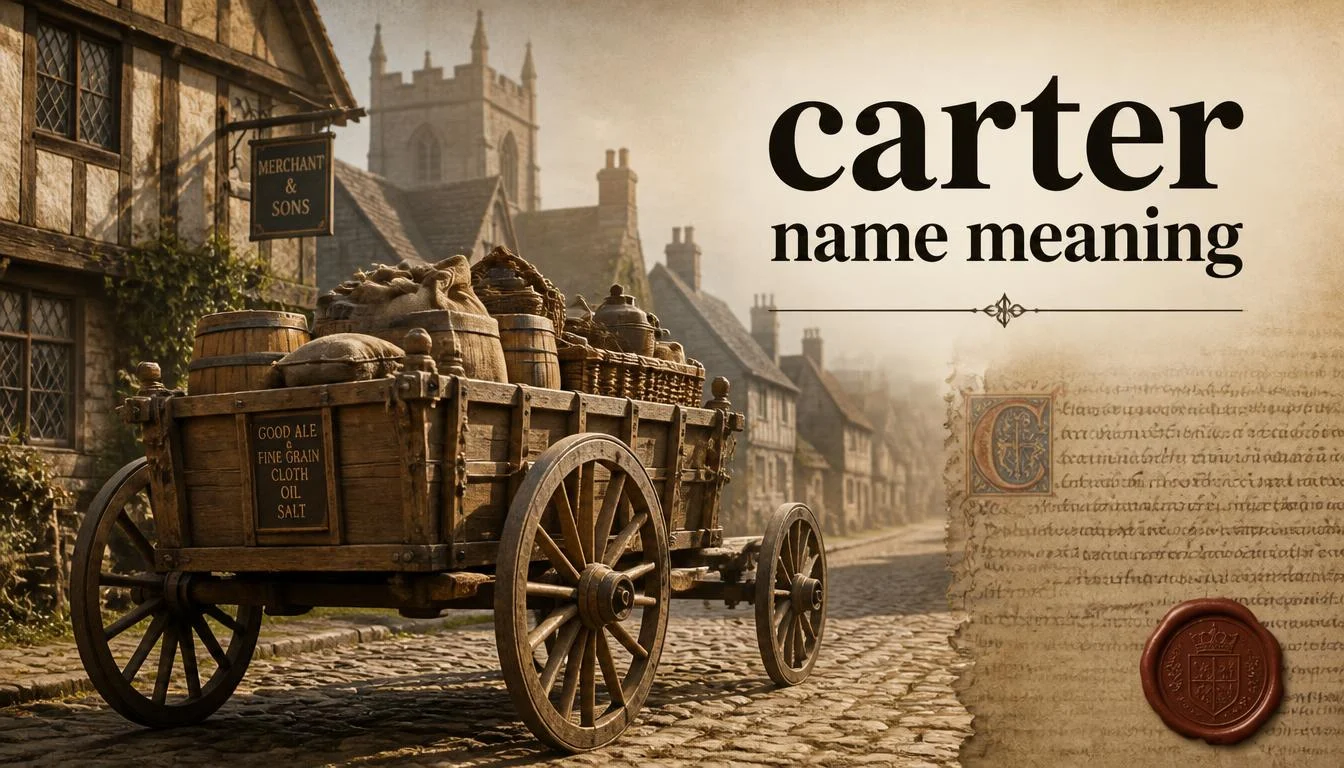
The carter name meaning is “one who uses a cart” or “transporter of goods by cart.” Carter began as an English occupational surname and later became a popular masculine given name.
The Carter name meaning comes from an English occupational surname traditionally associated with someone who transported goods by cart or worked as a cart driver. The surname developed from Middle English terms connected with a cart or wagon and the person who operated it. Over time, Carter moved beyond its occupational roots and became a well established given name, particularly in English speaking countries. Its practical origin gives the name a strong connection to work, movement, and traditional family occupations.
Today, Carter has a polished yet approachable character that works naturally as a first name. Its surname background gives it a distinctive heritage, while its simple pronunciation makes it easy to use across different English speaking communities. In this guide, we’ll explore the Carter name meaning, its English origin, etymology, historical development, pronunciation, cultural associations, variants, and modern use to give you a clear picture of what makes this name distinctive.
Key Facts
| Detail | Information |
|---|---|
| Gender | Boy / Masculine |
| Meaning | One who uses a cart; transporter of goods |
| Origin | English |
| Name Type | Occupational surname used as a given name |
| Pronunciation | KAR-ter |
| Related Form | Karter |
| Traditional Association | Cart driver or goods transporter |
What Is the Name Carter?
Carter is an English masculine given name derived from the surname Carter. The original surname described someone who operated a cart for transporting goods. In other words, the name directly reflected a person’s occupation.
This type of surname was common in medieval Europe. Communities often identified people by their work, location, family relationship, or personal characteristics. Names such as Carter, Carpenter, and Carver developed from this naming pattern.
As naming customs changed, many occupational surnames moved into everyday first name use.
- Carter followed that path and now functions independently as a given name.
Carter Name Meaning
- Carter has a practical meaning rooted in transportation and trade. The traditional interpretation is “one who uses a cart” or “transporter of goods by cart.”
Traditional Meaning
A carter worked with a cart to move goods from one place to another. Before modern trucks and delivery systems, carts played a central role in local trade and transportation.
Consequently, the name connects with work, movement, commerce, and practical service. It does not originally describe a personality trait such as “strong” or “brave”; those qualities sometimes appear in modern baby name descriptions, but they do not form the historical definition.
Modern Meaning
As a first name, Carter no longer refers literally to someone’s occupation. Parents generally choose it as a given name rather than to indicate that a child works with carts.
Still, the occupational origin gives Carter a distinctive historical character. It belongs to the large group of English surname-based names that have become established first names.
Origin and Etymology
Carter has English occupational origins. Historical surname sources connect it with Middle English carter(e) and related Anglo-Norman and Old French forms such as careter and charetier.
The underlying vocabulary relates to carts and the transportation of goods. Over time, English speakers developed the surname Carter to identify people whose occupation involved driving or operating carts.
The exact linguistic path contains several historical layers. Ancestry’s Dictionary of American Family Names material traces the occupational term through Middle English, Anglo-Norman French, Old French, and medieval Latin forms.
Therefore, “cart driver” provides a useful plain-English explanation, while “transporter of goods by cart” gives a more historically precise description.
History and Cultural Context
Carter began as a working surname in medieval England. Occupational surnames helped distinguish individuals within growing communities, particularly when many people shared the same personal names.
The name later crossed the Atlantic with English migration. Family history sources document Carter families in colonial America, including John Carter, who arrived in Jamestown in 1625.
Over the centuries, Carter developed a strong presence as a family name in English-speaking societies. Eventually, surname-to-first-name naming became increasingly common, giving Carter a new role as a personal name.
That transition matters because the modern first name does not represent a completely new invention. Instead, it carries forward an established English surname with centuries of occupational history.
Carter as a Baby Name
Carter works naturally as a modern first name while retaining its surname character. Its two syllables make it easy to say, and the spelling remains familiar to English speakers.
The name also pairs well with many traditional and contemporary middle names:
- Carter James
- Carter William
- Carter Alexander
- Carter Daniel
- Carter Thomas
- Carter Benjamin
Because Carter originated as a surname, it can create a polished surname-style combination with many classic first or middle names.
Examples of Carter in Use
Carter can appear in several ordinary naming contexts:
- Carter James Smith a traditional full name combination.
- Carter is starting school this year. ordinary conversational use.
- We chose Carter because we liked its English surname origin. a natural naming explanation.
- Carter and Mason a pairing of two modern surname style names.
- Mr. Carter the name also works naturally as a surname.
These examples show the name’s flexibility. It feels established as both a family name and a given name.
Variants and Spellings
The most clearly documented modern spelling variant is Karter. Behind the Name identifies Karter as a variant of Carter and lists it as a modern English name used for both masculine and feminine naming.
| Form | Usage | Relationship |
|---|---|---|
| Carter | English | Traditional surname and given name |
| Karter | Modern English | Spelling variant of Carter |
| Cartier | French surname | Historically related occupational surname in some contexts, but not simply an interchangeable spelling |
Carter itself remains the historically established form. Karter changes the initial letter but keeps the same basic pronunciation and naming association.
It is worth separating genuine variants from invented nicknames. Forms such as “Carty” may appear informally, but they do not have the same established status as Carter and Karter in major name references.
Famous People Named Carter
Carter appears in the names of several notable historical and modern figures.
- Carter G. Woodson American historian who founded the Association for the Study of Negro Life and History and helped establish what became Black History Month.
- Carter Braxton Virginia planter and political figure who signed the United States Declaration of Independence.
- Jimmy Carter the 39th president of the United States; his full name was James Earl Carter Jr.
- Carter Beauford American drummer and founding member of the Dave Matthews Band.
- Carter Jenkins American actor known for television and film work.
The name therefore appears in American history, scholarship, music, politics, and entertainment.
Carter vs. Related Terms
| Term | Meaning | How It Differs |
|---|---|---|
| Carter | One who uses a cart | English occupational surname and modern given name |
| Cartwright | Person who makes carts | Refers to cart-making rather than cart operation |
| Carpenter | Worker who makes or builds with wood | Broader woodworking occupation |
| Carver | Person who carves | Refers to carving rather than transportation |
| Karter | Variant of Carter | Modern spelling variant with the same basic name origin |
The distinction between Carter and Cartwright is especially useful. A Carter traditionally transported goods using a cart, while a Cartwright made carts.
FAQs
What does the name Carter mean?
Carter means “one who uses a cart” or “transporter of goods by cart.” It began as an English occupational surname connected with people who moved goods using carts.
What is the origin of the name Carter?
Carter has English occupational origins. Historical sources connect the surname with Middle English and Anglo-Norman or Old French terms for a person who transported goods by cart.
Is Carter a boy’s name or a girl’s name?
Major name references classify Carter as masculine in its traditional given-name use. Modern naming practices can vary, though, and some sources describe contemporary Carter usage as unisex.
How do you pronounce Carter?
Carter has two syllables and uses the pronunciation KAR-ter in a simple English phonetic spelling. American English and British English differ slightly in their final vowel sound.
Is Carter a surname or a first name?
Carter is both. It began as an English occupational surname, but people now use Carter as a given name as well. This surname-to-first-name transition has become common with many English family names.
Is Karter a variant of Carter?
Yes. Karter is a documented modern variant of Carter. It keeps the same basic pronunciation and meaning while changing the spelling.
Does Carter have a biblical meaning?
Carter does not have a biblical origin. Its roots come from an English occupational surname connected with cart transportation. Therefore, descriptions that give Carter a biblical meaning do not match its documented etymology.
Conclusion
Carter began as an English occupational surname for someone who transported goods by cart and later developed into a modern given name. Its meaning connects with transportation and practical work, while its surname history gives it a distinctly English character. Today, Carter blends historical roots with contemporary naming style.
Read More Articles
- Maverick Name Meaning | Why This Bold Name Stands Out In 2026
- Ari Name Meaning | A Short Name With a Rich History In 2026











1 thought on “Carter Name Meaning | Origin, Etymology and Modern Use In 2026”