Quick Answer
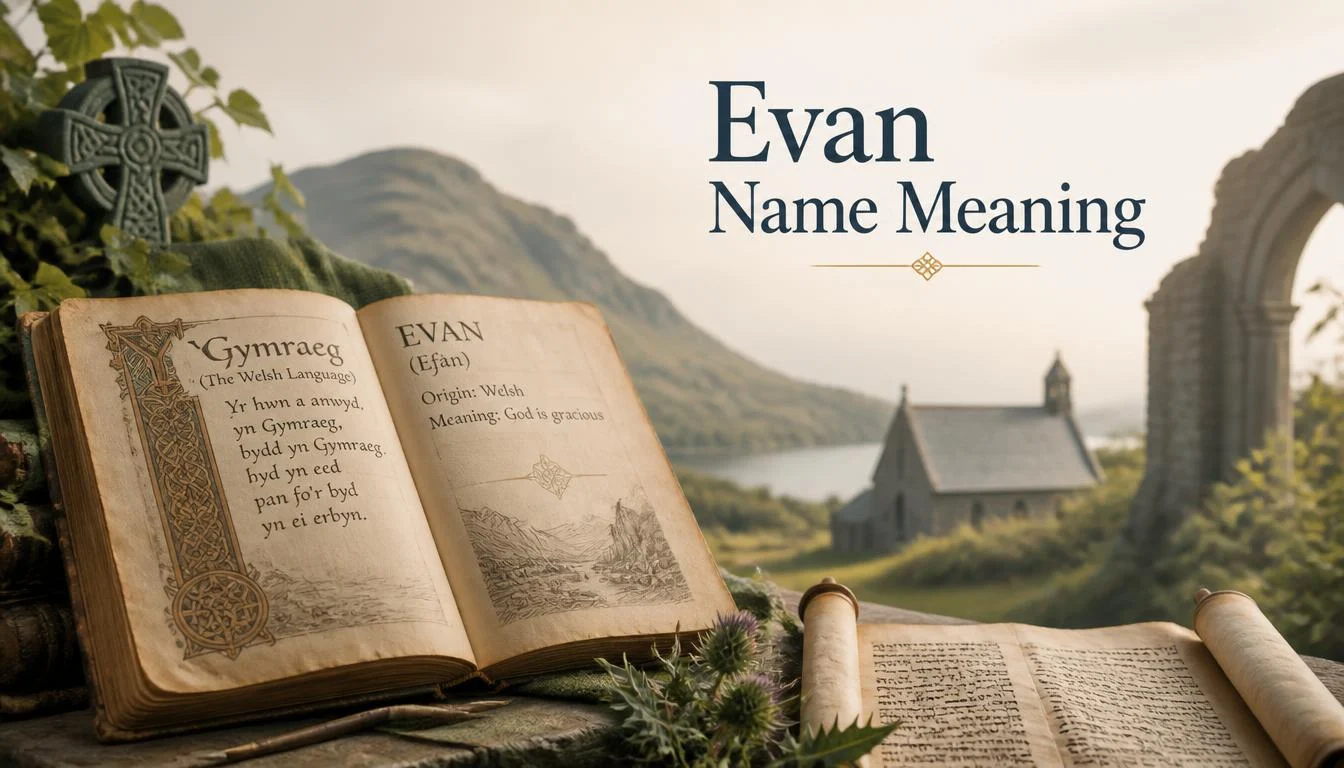
The Evan name meaning comes from the Welsh form Ifan, which developed from John. Its traditional meaning is “Yahweh is gracious” or “God is gracious.”
The Evan name meaning has deep Welsh roots and is closely connected to the name Ifan, a Welsh form of John. The name is commonly understood to mean “the Lord is gracious” or “God is gracious,” giving Evan a warm and meaningful association with grace and blessing. Its simple pronunciation and timeless character have helped it remain familiar across generations and cultures.
Evan also has a rich history beyond its traditional meaning. It has long been used as a given name in Wales and later became popular in English-speaking countries, where its short, approachable sound made it an appealing choice for parents. In this guide, we’ll explore the origin, history, meaning, pronunciation, popularity, variations, and cultural significance of the name Evan.
Key Facts
| Feature | Details |
|---|---|
| Gender | Boy / Masculine |
| Meaning | “Yahweh is gracious” or “God is gracious” |
| Origin | Welsh, ultimately from Hebrew through John |
| Pronunciation | EE-vən |
| Welsh Forms | Ifan, Ieuan, Iefan, Ioan, Iwan |
| Related Surname | Evans |
What Is Evan?
Evan is a masculine given name used in both Welsh and English. It represents the Anglicized form of the Welsh name Ifan, a form of John. Although the modern spelling looks different from John, both names belong to the same linguistic family and share the same underlying Hebrew source.
The name has a particularly strong connection with Wales. Welsh forms such as Ifan, Ieuan, Iefan, and Ioan show how the name developed within Welsh naming traditions. Evan later became familiar beyond Wales and now functions naturally as an English given name as well.
Evan should not be confused with Evans. Evans began as a Welsh patronymic surname derived from Evan. In other words, the two names share a direct historical relationship, but they serve different naming roles.
Evan Name Meaning
The traditional meaning of Evan comes from the meaning of John: “Yahweh is gracious.” In simpler English, people often express the meaning as “God is gracious.”
Religious Meaning
The name ultimately connects to the Hebrew Yochanan, a name built from elements associated with Yahweh and grace or favor. John became a major biblical name, and its many linguistic forms spread across Europe and beyond.
Because Evan belongs to this family, it carries the same traditional religious meaning even though its Welsh development gives it a different appearance from John.
Modern Meaning and Associations
Today, parents usually choose Evan because of its sound, cultural background, familiarity, or connection with Welsh heritage rather than because they expect the literal meaning to define a child’s personality.
Still, the traditional idea of grace or divine favor gives Evan a positive historical association. The name feels concise and approachable while retaining a long religious and linguistic background.
Origin and Etymology
Evan has a clear linguistic path: Hebrew → Greek and Latin forms of John → Welsh Ifan → English Evan. The name did not originate as a separate English word with its own unrelated meaning.
The Hebrew name Yochanan became Ioannes in Greek and Latin traditions. From related forms of John, Welsh developed Ifan and other variants. English then adopted Evan as an Anglicized form of the Welsh name.
Welsh has several related forms, including Ieuan, Iefan, Ioan, and Iwan. These forms reflect the linguistic history of the same broader name family rather than completely separate naming traditions.
This history also explains why Evan and John can feel very different while sharing a common origin. Names often change substantially as they move between languages, and Evan provides a good example of that process.
History and Cultural Context
Evan’s strongest historical identity comes from Wales, where Welsh forms of John developed their own established forms. The name later gained wider use in English-speaking communities, especially where Welsh names and surnames became familiar.
The surname Evans provides another important connection. Evans derives from Evan and originally functioned as a patronymic surname, essentially identifying someone as the descendant or family member of an Evan.
That relationship gives Evan an unusual place in English-language naming history. It exists as a given name, while its related form Evans became a prominent Welsh surname.
Over time, Evan moved beyond its specifically Welsh setting. Its short spelling and straightforward pronunciation helped it fit naturally into modern English naming patterns. It remains recognizable without losing its connection to Welsh linguistic history.
Pronunciation and Usage
Evan is commonly pronounced EE-vən, with the first syllable carrying the main stress. The pronunciation has two syllables and usually sounds much like “EE-vuhn.”
The spelling is simple, which makes the name relatively easy to recognize in English. Welsh forms such as Ifan or Ieuan, by contrast, may look less familiar to people who have not encountered Welsh naming traditions.
Evan is traditionally masculine. However, real-world naming practices can vary, and some people use traditionally masculine names for girls or as gender-neutral choices. Evan Rachel Wood, for example, is a well-known female bearer of the name.
Examples of Evan in Use
Evan works naturally as a first name in several naming styles.
- Evan James has a traditional, balanced sound.
- Evan Thomas combines two names with strong British and Welsh associations.
- Evan Alexander gives the short first name a longer formal counterpart.
- Evan Michael pairs the name with another established biblical name.
The name can also appear in surname history. Evans comes directly from Evan, making it an important example of how a personal name can develop into a hereditary surname.
In everyday writing, Evan functions like other familiar first names:
- “Evan joined the school team this year.”
- “We chose Evan because we liked its Welsh roots.”
- “Evan was named after his grandfather.”
These examples show how easily the name fits both traditional and contemporary settings.
Variants and Spellings
Evan has several genuine Welsh forms and related names. The differences often reflect language, spelling tradition, or historical development.
| Name | Language / Use | Relationship |
|---|---|---|
| Evan | Welsh, English | Anglicized form of Ifan |
| Ifan | Welsh | Welsh form connected to John |
| Ieuan | Welsh | Related Welsh form of John |
| Iefan | Welsh | Variant Welsh form |
| Ioan | Welsh | Welsh form related to John |
| Iwan | Welsh | Related Welsh form |
| John | English | English form from the same wider name family |
| Evans | Welsh/English surname | Surname derived from Evan |
Behind the Name lists Ifan, Ieuan, Iefan, Ioan, and Iwan among Evan’s Welsh variants.
The surname Evans deserves separate attention because it did not simply arise as another spelling of Evan. It developed from Evan and became established as a family name.
Famous People Named Evan
Several notable people have carried the name Evan across entertainment and sport.
- Evan Peters is an American actor known for television and film roles, including his work in American Horror Story.
- Evan Rachel Wood is an American actress, director, and writer known for Westworld, Thirteen, and other film and television projects.
- Evan Lysacek is an American figure skater who won the men’s singles gold medal at the 2010 Winter Olympics.
- Evan Longoria is an American professional baseball player who spent much of his Major League Baseball career with the Tampa Bay Rays.
These examples also show that Evan appears in different generations and professional fields, rather than belonging to one particular occupation or cultural group.
Evan vs. Related Terms
| Term | Meaning | How It Differs |
|---|---|---|
| Evan | “Yahweh is gracious” | Welsh-derived English given name |
| Ifan | Form of John | Welsh form from which Evan developed |
| John | “Yahweh is gracious” | English form of the same broader name family |
| Evans | Surname derived from Evan | Family name rather than the standard given-name form |
| Ian | Form of John | Scottish form rather than Welsh Evan |
Evan and John share the same deeper origin, but their paths through different languages produced distinct modern names. Ifan has the closest direct Welsh relationship to Evan, while Evans belongs to the surname tradition.
FAQs
Is Evan a Welsh name?
Yes. Evan is used in Welsh and English, and its Welsh history is central to the name’s development. It represents an Anglicized form of the Welsh Ifan.
What does the name Evan mean?
Evan traditionally means “Yahweh is gracious” or “God is gracious.” The meaning comes through its connection with John and the Hebrew name Yochanan.
Is Evan a biblical name?
Evan itself is not the usual biblical form of the name, but it belongs to the same name family as John, which has biblical roots. Evan developed through Welsh from forms of John.
Is Evan a boy or girl name?
Evan is traditionally a masculine name. In modern usage, though, individuals may use traditionally masculine names in different ways. Evan Rachel Wood is one well-known example of a woman named Evan.
How do you pronounce Evan?
Evan is commonly pronounced EE-vən, with two syllables and emphasis on the first syllable.
What is the Welsh version of Evan?
Ifan is the Welsh form directly associated with Evan. Other related Welsh forms include Ieuan, Iefan, Ioan, and Iwan.
Is Evans related to Evan?
Yes. Evans developed as a Welsh surname derived from Evan. The two names therefore share a direct historical connection, although Evan functions primarily as a given name while Evans functions as a surname.
Conclusion
Evan is a Welsh-derived name with a long linguistic history and the traditional meaning “Yahweh is gracious.” Its connection to Ifan and John gives it both Welsh character and broader biblical roots. With its simple pronunciation and established history, Evan remains a recognizable name that carries a meaningful connection to Welsh naming traditions.
Read More Articles
- Carter Name Meaning | Origin, Etymology and Modern Use In 2026
- Zoe Name Meaning | Origin, Symbolism and Name Traits In 2026











2 thoughts on “Evan Name Meaning |History, Roots, Variations and Popularity In 2026”