Quick Answer
Declan is an Irish masculine name derived from Irish Deaglán and Old Irish Declán. Its exact original meaning remains uncertain, although some sources connect its first element with the Old Irish dag, meaning “good.”
The Declan name meaning has strong Irish roots and a long connection to early Christian history. Declan is traditionally associated with the Old Irish name Declán and is often linked with the meaning “full of goodness” or “man of prayer,” although interpretations can vary depending on the source and linguistic tradition. The name carries a distinctly Irish character and has remained recognizable well beyond its historical roots.
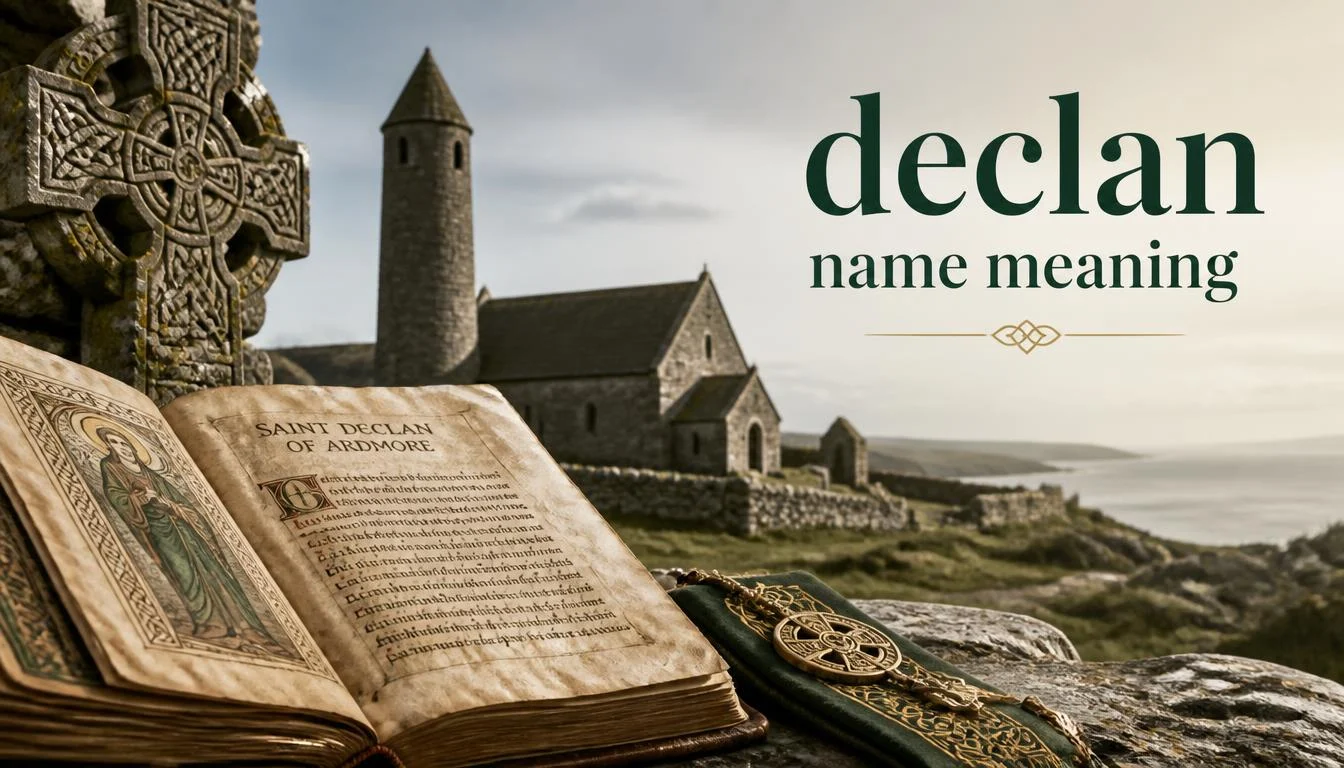
Declan also has an interesting place in Irish history through Saint Declan, a fifth-century Christian figure associated with Ardmore in County Waterford. Today, the name appeals to parents who want a traditional Irish name that still feels modern and approachable. Its clear pronunciation, rich heritage, and distinctive sound give Declan a timeless quality that works well across generations.
Key Facts
| Feature | Details |
|---|---|
| Gender | Boy / Masculine |
| Meaning | Exact meaning uncertain; possibly connected with “good” |
| Origin | Irish, from Old Irish |
| Irish Form | Deaglán |
| Older Form | Declán |
| Pronunciation | DEK-lən |
| Associated Saint | Saint Declan of Ardmore |
| Related Language | Irish |
What Is Declan?
Declan is a masculine given name of Irish origin. The modern English form represents an anglicized version of the Irish Deaglán, which traces back to Old Irish Declán.
The name is especially associated with Saint Declan, traditionally regarded as a fifth-century missionary to the Déisi people of Ireland. He is closely linked with Ardmore, where a monastery is traditionally attributed to him.
Unlike names whose ancient meanings remain clear, Declan presents a linguistic puzzle. Reliable name references describe its meaning as unknown, while suggesting that its beginning may relate to the Old Irish element dag, meaning “good.”
Declan Meaning
The safest answer is that Declan has no securely established literal meaning. Popular explanations sometimes translate it as “full of goodness” or “man of prayer,” but those interpretations should not be presented as proven etymology.
The Possible “Good” Connection
One scholarly name reference notes that Declan likely begins with the Old Irish prefix dag, associated with “good.” That gives the name a possible connection with goodness, but the complete historical construction remains uncertain.
For that reason, “good” works better as a possible linguistic association than as a definitive translation.
Why “Man of Prayer” Appears Online
You may encounter “man of prayer” as a proposed meaning for Declan. This interpretation appears in popular name discussions, but it lacks the same firm linguistic support as the documented connection between Declan, Deaglán, and Saint Declan.
The historical association with an Irish saint may help explain why religious interpretations became attached to the name. Still, the two ideas should not be treated as identical.
Origin and Etymology
Declan comes from the Irish Deaglán, with the older form Declán recorded in Old Irish. The English spelling developed as an anglicized form of the Irish name.
A 1923 reference by Rev. Patrick Woulfe lists Déaglán as the Irish form of Declan and identifies it with the patron saint of Ardmore. It also gives the Latin form as Declanus.
The etymology remains partly unresolved. Modern reference material specifically describes the original meaning as unknown while proposing a possible connection to dag, “good.” That distinction matters because a name can have a well-documented history even when its earliest linguistic meaning has disappeared.
History and Cultural Context
Declan’s history is closely tied to Saint Declan, traditionally placed in fifth-century Ireland. Sources describe him as a missionary among the Déisi and associate him with the foundation of a monastery at Ardmore.
Ardmore is particularly significant because Declan became its patron saint. Woulfe’s Irish Names and Surnames records that his feast day was observed on July 24 and describes the name as particularly associated with County Waterford.
Irish naming traditions also gave saints an important place in personal naming. Historical Irish naming material notes that families sometimes chose names connected with particular saints or traditional family usage.
The modern form Declan therefore reflects both linguistic change and the long survival of an Irish saint’s name.
Declan Pronunciation and Usage
In English, Declan is commonly pronounced DEK-lən, with the stress on the first syllable. The pronunciation is straightforward once the spelling becomes familiar.
The name appears in both Irish and English usage today. Its Irish form is Deaglán, while Declán represents the older Irish form.
For parents considering the name, Declan offers a recognizable English spelling while retaining a clear connection to Irish heritage.
Examples of Declan in Use
Here are a few natural examples:
- Declan was named after his grandfather’s Irish heritage.
- The family chose Declan because they wanted a traditional Irish name.
- Declan is an English form connected with the Irish name Deaglán.
- Saint Declan is strongly associated with Ardmore in Ireland.
As a naming choice, Declan fits naturally alongside other established Irish names such as Cillian, Ronan, Kieran, and Eoghan.
Variants and Spellings
Declan has a small but historically meaningful group of related forms.
| Form | Language / Period | Relationship |
|---|---|---|
| Declan | Irish, English | Modern anglicized form |
| Deaglán | Irish | Irish form of Declan |
| Declán | Old Irish | Older historical form |
| Declanus | Latin | Latin form recorded in historical naming references |
The forms Deaglán and Declán are especially useful when researching the name’s Irish background.
Famous People Named Declan
Several notable people carry the name Declan, particularly in entertainment and public life.
- Declan McManus, better known professionally as Elvis Costello, is an English musician whose birth name is Declan Patrick MacManus.
- Declan Rice is an English professional footballer.
- Declan Donnelly is an English television presenter and entertainer, known as one half of the presenting duo Ant & Dec.
- Declan Galbraith is a British singer who gained attention as a child performer.
These examples show how the traditional Irish name has moved comfortably into modern English-speaking culture.
Declan vs. Related Terms
| Term | Meaning | How It Differs |
|---|---|---|
| Declan | Irish masculine given name | Modern English form connected with Deaglán |
| Deaglán | Irish form of Declan | Native Irish form |
| Declán | Old Irish form | Historical linguistic form |
| Declanus | Latin form | Latinized version recorded in historical sources |
| Saint Declan | Early Irish Christian saint | Historical person associated with the name |
The key distinction is between the name itself and its historical forms. Saint Declan is the person who helped preserve the name’s cultural identity, while Deaglán and Declán represent its linguistic history.
FAQs
Is Declan an Irish name?
Yes. Declan is an Irish name used in both Irish and English. It comes from Irish Deaglán and the older Declán.
What does the name Declan mean?
The exact original meaning remains uncertain. Some sources suggest a connection with the Old Irish element dag, meaning “good,” but the complete etymology has not been firmly established.
Is Declan a boy’s name or a girl’s name?
Declan is traditionally a masculine or boy’s name. Major name references classify it as masculine.
How do you pronounce Declan?
Declan is commonly pronounced DEK-lən, with the emphasis on the first syllable.
What is the Irish version of Declan?
Deaglán is the Irish form of Declan. Declán represents an older Irish form.
Who was Saint Declan?
Saint Declan was a fifth-century Irish missionary associated with the Déisi people and Ardmore. Traditional accounts connect him with the founding of a monastery there.
Is Declan a religious name?
Declan has strong Christian historical associations because of Saint Declan. Still, the name itself does not have a securely established meaning such as “prayer” or “faith.”
Conclusion
Declan is a traditional Irish masculine name with a history reaching back to Deaglán and Old Irish Declán. Its exact original meaning remains uncertain, although “good” may form part of its earliest linguistic background. Its strongest cultural association comes from Saint Declan and his historic connection with Ardmore, Ireland.
Read More Articles
- Zion Name Meaning |Origin, History and Significance In 2026
- Sienna Name Meaning | Origin, History and Significance In 2026











1 thought on “Declan Name Meaning | Irish Roots, History and Symbolism In 2026”