Quick Answer
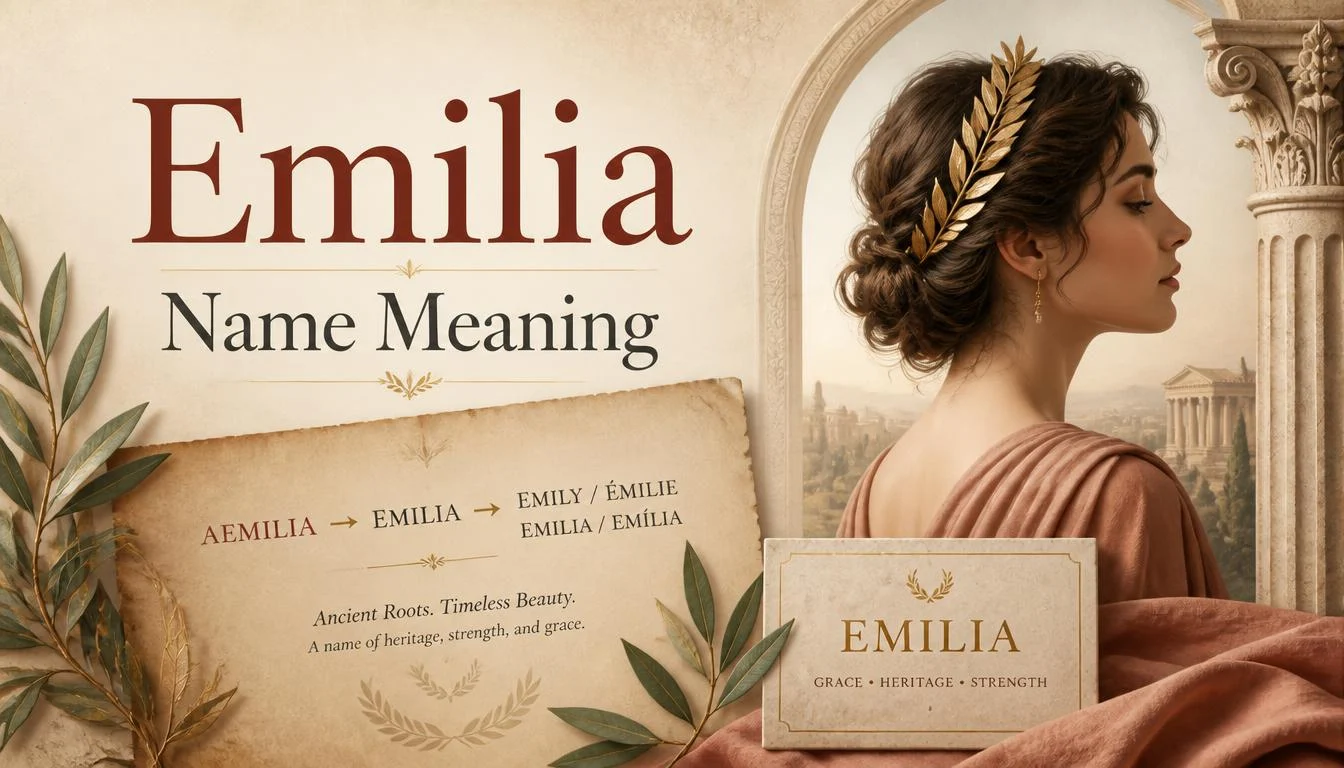
Emilia is a feminine name derived from the ancient Roman name Aemilia, the feminine form of Aemilius. Its traditional etymological connection is the Latin aemulus, meaning “rival” or “one who strives to equal or excel.”
The Emilia name meaning has deep roots in European naming traditions and connects to the ancient Roman family name Aemilius. The name is commonly associated with qualities such as striving, ambition, and determination. Over time, Emilia developed across different languages and cultures, giving it a graceful sound while preserving its connection to a much older historical tradition.
Today, Emilia appeals to parents who want a name that feels elegant, classic, and internationally familiar. Its history reaches back to ancient Rome, while its continued use gives it a modern presence in many parts of the world. In this guide, you will discover the meaning, origin, history, pronunciation, variations, and cultural background of the name Emilia.
Key Facts
| Fact | Details |
|---|---|
| Gender | Girl |
| Meaning | Rival; striving to equal or excel |
| Origin | Latin / Ancient Roman |
| Original Form | Aemilia |
| Pronunciation | eh-MEE-lee-ah |
| Related Names | Emily, Emilie, Emília, Emilija |
| Short Forms | Em, Emmy, Emmie, Millie, Milly |
What Is Emilia?
Emilia is a feminine given name with ancient Roman roots. Its earliest form, Aemilia, represents the feminine counterpart of Aemilius, a Roman family name associated with the gens Aemilia, one of Rome’s prominent families.
The name traveled through different European languages over many centuries. As a result, Emilia now appears in several naming traditions rather than belonging exclusively to one modern country.
It also differs from Amelia, despite the similar sound. Emilia belongs to the Aemilius name family, while Amelia has a different history and later became associated with the Roman Aemilia family name.
Emilia Name Meaning
The strongest historical explanation connects Emilia with the Latin aemulus, meaning “rival” or “one who strives to equal another.” The related English word emulate comes from the same Latin family.
That meaning does not necessarily suggest hostility or conflict. In its broader sense, emulation can describe the desire to match or surpass an admired standard. Therefore, Emilia can carry an associated idea of ambition, striving, and determination.
Some older traditions have proposed alternative interpretations connected with graceful or engaging speech, including a story recorded by the Roman historian Plutarch. That explanation belongs to ancient literary tradition, while the linguistic connection with aemulus provides the clearer etymological basis.
Origin and Etymology
Emilia’s oldest recognizable form is Aemilia, the feminine form of Aemilius in Ancient Rome. Aemilius functioned as a Roman family name and later produced related personal names throughout Europe.
The Latin root aemulus carried meanings connected with rivalry, imitation, and striving to equal or surpass someone. From this linguistic family came words such as emulation and emulate.
Over time, related forms developed in French, German, Italian, Spanish, English, and many other languages. Emilia remains especially recognizable in Italian and Spanish, while related forms include Emily, Émilie, and Emília.
History and Cultural Context
Emilia has a long literary history beyond its Roman roots. Giovanni Boccaccio used Emilia for a character in his 14th-century epic poem Teseida. Centuries later, Shakespeare used the name for Iago’s wife in Othello, first performed around 1603.
Shakespeare’s Emilia gives the name a particularly memorable place in English literature. She plays an important role in the tragedy and delivers several of its significant observations about marriage, gender, and social expectations.
The name also appears in many European naming traditions. Modern usage records Emilia in Italian, Spanish, Romanian, Finnish, Polish, German, Swedish, Norwegian, Danish, English, Greek, and Bulgarian contexts.
Examples
Parents may choose Emilia because it combines a classical origin with a familiar modern sound. It works naturally with both short and long surnames.
Here are a few practical examples:
- Emilia Rose a soft, traditional combination.
- Emilia Claire pairs the longer first name with a concise middle name.
- Emilia Grace gives the full name a classic rhythm.
- Emilia James demonstrates how Emilia can pair with a less traditionally feminine middle name.
In everyday speech, English speakers commonly pronounce Emilia approximately as eh-MEE-lee-ah. Pronunciation varies somewhat across languages. For example, Italian and Spanish forms use slightly different vowel and stress patterns.
Variants and Spellings
Emilia has a broad family of genuine linguistic relatives.
| Form | Language or tradition |
|---|---|
| Aemilia | Ancient Roman |
| Emilia | Italian, Spanish, Romanian, and several other languages |
| Emily | English |
| Émilie | French |
| Emília | Portuguese, Slovak, Hungarian |
| Emilija | Several Slavic languages |
| Emiliya | Bulgarian and some Slavic traditions |
| Emilie | German, Scandinavian, and other European usage |
Short forms also vary by language. English diminutives include Emmy, Emmie, Em, Millie, and Milly, while other languages have their own familiar forms.
Famous People Named Emilia
Emilia Clarke is an English actress known internationally for playing Daenerys Targaryen in Game of Thrones. She has also appeared in Terminator Genisys, Me Before You, and Solo: A Star Wars Story.
Æmilia Lanyer was an English poet of the late 16th and early 17th centuries. Born Aemilia Bassano, she published Salve Deus Rex Judæorum in 1611 and holds an important place in the history of early English women’s poetry.
- Emilia Pardo Bazán was a major Spanish writer and intellectual of the 19th and early 20th centuries, particularly associated with Spanish naturalism and literary criticism.
Emilia vs. Related Terms
| Term | Meaning | How It Differs |
|---|---|---|
| Emilia | Traditional feminine form related to Aemilius | The main name discussed here |
| Emily | English feminine form of the same Latin family | More strongly established as the English form |
| Emilie | European form related to Emilia and Emily | Common in French, German, and Scandinavian contexts |
| Amelia | A separate given name with a different history | Similar sound but different etymological development |
- Emilia and Emily are especially close relatives. Both ultimately connect with the Latin Aemilia, although each developed through different linguistic pathways.
FAQs
Is Emilia a biblical name?
No. Emilia does not originate as a biblical name. Its documented roots lead to the ancient Roman name Aemilia and the Latin Aemilius family.
What does the name Emilia mean?
Emilia traditionally connects with the Latin aemulus, giving it the sense of “rival,” “striving,” or “one who seeks to equal or excel.”
Is Emilia an Italian name?
Emilia is strongly associated with Italian usage, but it is not exclusively Italian. The name also appears in Spanish, Romanian, German, Polish, Scandinavian, English, Greek, and other naming traditions.
Is Emilia the same name as Emily?
They are closely related rather than completely unrelated names. Both developed from the Latin Aemilia family, but Emily became the established English form while Emilia retained a more Romance and continental European form.
How do you pronounce Emilia?
In English, a simple pronunciation is eh-MEE-lee-ah. Italian, Spanish, Finnish, Polish, and other languages may use different vowel sounds or stress patterns.
Is Emilia a feminine name?
Yes. Emilia is traditionally a feminine given name and is listed as feminine across the major naming traditions in which it appears.
Is Emilia the same as Amelia?
No. The names sound similar, but they have different etymological histories. Emilia comes from the Aemilius/Aemilia Roman name family, while Amelia developed through a separate Germanic-related tradition and later became associated with Aemilia.
Conclusion
Emilia is a feminine name with a rich Roman foundation and a meaning linked to rivalry, striving, and emulation. Its long history connects Ancient Rome with European languages and literature, while forms such as Emily and Émilie show how widely the name family has traveled. For parents seeking a classic name with international familiarity, Emilia carries both historical depth and a graceful modern sound.
Read More Articles
- Molly Name Meaning | Origins, Personality and Cultural Significance In 2026
- Austin Name Meaning | Biblical Roots, History and Symbolism In 2026











2 thoughts on “Emilia Name Meaning | Origin, Meaning, Pronunciation and More In 2026”