Quick Answer
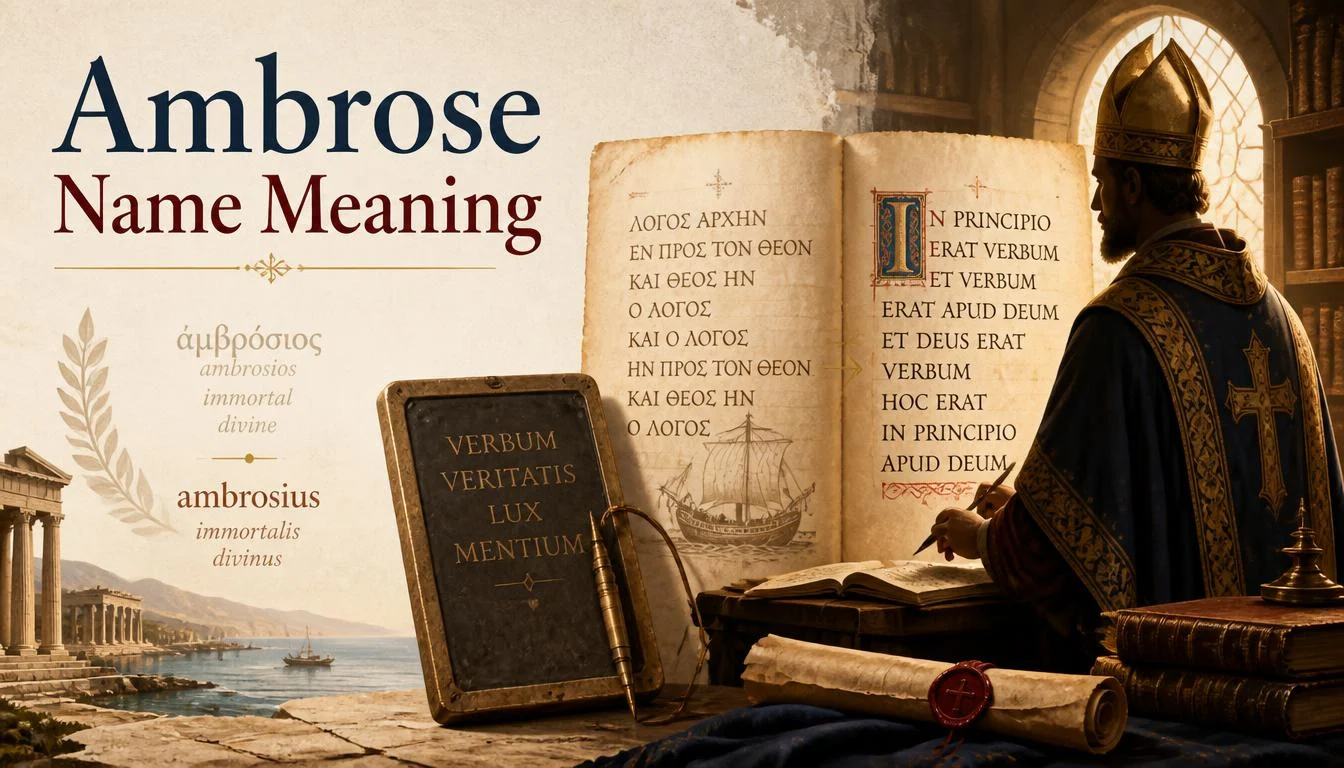
Ambrose is a masculine English name derived from the Greek Ambrosios, through Late Latin Ambrosius, meaning “immortal.” Its history is strongly connected with Saint Ambrose, the influential fourth-century Bishop of Milan.
The Ambrose name meaning has roots in the ancient Greek word ambrosios, which means “immortal” or “divine.” The name carries a sense of lasting life, heavenly qualities, and timeless strength. It entered wider European use through early Christian history, especially through Saint Ambrose of Milan, a respected fourth-century bishop and writer. Because of these religious and classical connections, Ambrose has retained a distinguished character across generations.
Ambrose also has an elegant, traditional sound that gives it a distinctive place among classic names. Its Greek origin, historical associations, and connection with Saint Ambrose make the name appealing to families who value names with depth and heritage. Whether you are researching the Ambrose name meaning for a baby, exploring family history, or simply curious about its origins, understanding its language, history, and cultural background reveals why this old-fashioned name continues to attract attention.
Key Facts
| Fact | Details |
|---|---|
| Gender | Boy / Masculine |
| Meaning | “Immortal” |
| Origin | Ancient Greek, through Late Latin |
| Original Form | Ambrosios |
| Latin Form | Ambrosius |
| Pronunciation | AM-brohz |
| English Use | Ambrose |
| Famous Association | Saint Ambrose of Milan |
What Is Ambrose?
Ambrose is a masculine given name of Greek origin that entered English through Latin. Its earliest recorded form is the Greek Ambrosios, while Ambrosius represents its Latinized form. The name ultimately carries the meaning “immortal.”
In English, Ambrose has a distinctly traditional character. It does not simply function as an English word; it belongs to an older European naming tradition shaped by Greek language, Roman culture, and Christian history.
The name differs from modern names created from ordinary English vocabulary because its meaning comes from an ancient linguistic root rather than a contemporary descriptive word.
Ambrose Name Meaning
The central meaning of Ambrose is “immortal.” The Greek form Ambrosios supplied the linguistic foundation for the later Latin and English forms.
Literal Meaning
The traditional interpretation connects Ambrose with the idea of being immortal or imperishable. That meaning gives the name an enduring quality without requiring a modern symbolic interpretation.
Religious Meaning
Christian history added another layer to Ambrose. Saint Ambrose of Milan became one of the major theological figures of the fourth-century Western Church. Because of his influence, the name gained a lasting association with Christian tradition.
Modern Impression
Today, Ambrose often feels classic, formal, literary, and old-fashioned in English. Those impressions describe modern naming style rather than the name’s original definition.
Origin and Etymology
Ambrose ultimately comes from Ancient Greek Ἀμβρόσιος (Ambrosios). The name passed into Late Latin as Ambrosius, which became the source of English Ambrose.
The Greek form appears in the Lexicon of Greek Personal Names, while traditional Greek lexicographical sources connect ambrosios with the meaning “immortal.”
The linguistic progression can therefore be summarized as:
Greek Ambrosios → Latin Ambrosius → English Ambrose
This path also explains why related forms appear across several European languages.
History and Cultural Context
Saint Ambrose gave the name an especially important place in Christian history. Born around 340 and raised in a Roman Christian family, Ambrose pursued a legal and administrative career before becoming Bishop of Milan in 374.
His appointment was unusual. Ambrose served as a Roman governor in Milan when a dispute arose over the city’s next bishop. He intervened to maintain order, and the gathered crowd chose him for the position. He then received baptism and quickly entered the episcopate.
As bishop, Ambrose became an influential theologian, preacher, and church leader. His writings and hymns contributed significantly to Western Christian tradition, and the Catholic Church recognizes him as a Doctor of the Church.
His influence helped the name spread beyond its ancient linguistic roots. Ambrose became part of the wider naming tradition of Christian Europe, although it never became particularly common in England.
Examples
Ambrose works naturally in several naming contexts:
- Ambrose James a formal first and middle combination.
- Ambrose William a traditional combination with another classic name.
- Ambrose suitable when parents want a historical name with a strong classical background.
- Saint Ambrose the historical religious reference most strongly associated with the name.
In a sentence, you might write: “Ambrose is an old English form of the Latin Ambrosius.”
The name can also appear in historical, literary, and biographical contexts, where its traditional character fits naturally.
Variants and Spellings
Ambrose has genuine equivalents and related forms in several languages.
| Language | Form |
|---|---|
| Ancient Greek | Ambrosios |
| Latin | Ambrosius |
| English | Ambrose |
| French | Ambroise |
| Italian | Ambrogio |
| Spanish | Ambrosio |
| Portuguese | Ambrósio |
| Hungarian | Ambrus |
| Dutch | Ambroos |
| Croatian | Ambrozije |
| Czech / Slovene | Ambrož |
| Polish | Ambroży |
| Georgian | Ambrosi |
Ambrosine appears as a rare English feminine form.
These forms share the same historical naming family, although pronunciation and spelling vary by language.
Famous People Named Ambrose
Several notable historical figures carried Ambrose as a first or middle name.
- Saint Ambrose of Milan (c. 340–397) fourth century bishop, theologian, and Doctor of the Church.
- Ambrose Bierce (1842–c. 1914) American writer, journalist, and author known for The Devil’s Dictionary.
- Ambrose Burnside (1824–1881) American Civil War general who later served as governor of Rhode Island and a U.S. senator.
- Ambrose Olsen (1985–2010) American model and actor.
These examples show how Ambrose has appeared in religious history, literature, military history, and popular culture.
Ambrose vs. Related Terms
| Term | Meaning | How It Differs |
|---|---|---|
| Ambrose | “Immortal” | English form of the name |
| Ambrosios | “Immortal” | Ancient Greek form |
| Ambrosius | “Immortal” | Latinized form |
| Ambroise | Same name family | French form |
| Ambrogio | Same name family | Italian form |
| Ambrosio | Same name family | Spanish form |
The forms are closely related, but they belong to different linguistic traditions.
FAQs
1. What does the name Ambrose mean?
Ambrose traditionally means “immortal.” It comes from the Ancient Greek Ambrosios through the Late Latin Ambrosius.
2. Is Ambrose a Greek name?
Yes. Its earliest form, Ambrosios, comes from Ancient Greek. The English form reached the language through the Latin Ambrosius.
3. Is Ambrose a boy’s name?
Yes. Ambrose is traditionally a masculine name in English usage.
4. How do you pronounce Ambrose?
Ambrose is commonly pronounced AM-brohz in English. The final syllable sounds like “rose.”
5. What is the biblical meaning of Ambrose?
Ambrose is not a biblical name in the usual sense. Its roots are Greek, and its major religious association comes from Saint Ambrose, a fourth-century Christian bishop.
6. What are the variants of Ambrose?
Related forms include Ambrosios, Ambrosius, Ambroise, Ambrogio, Ambrosio, Ambrus, Ambrož, and Ambroży.
7. Is Ambrose a rare name?
Ambrose has a long history but has not traditionally been among the most common English names. Its continued use is closely tied to its classical and religious heritage.
8. Who was Saint Ambrose?
Saint Ambrose was the Bishop of Milan from 374 until his death in 397. He became an influential theologian and one of the Doctors of the Western Church.
Conclusion
Ambrose combines an ancient Greek meaning “immortal” with a long Latin, English, and Christian history. Its strongest historical association comes from Saint Ambrose of Milan, while its international variants connect it with several European languages. For parents seeking a masculine name with classical depth and enduring historical significance, Ambrose offers a distinctly traditional choice.
Read More Articles
- Peter Name Meaning | History, Roots, Pronunciation and More In 2026
- Vera Name Meaning | History, Origin, Gender and Significance In 2026










