Quick Answer
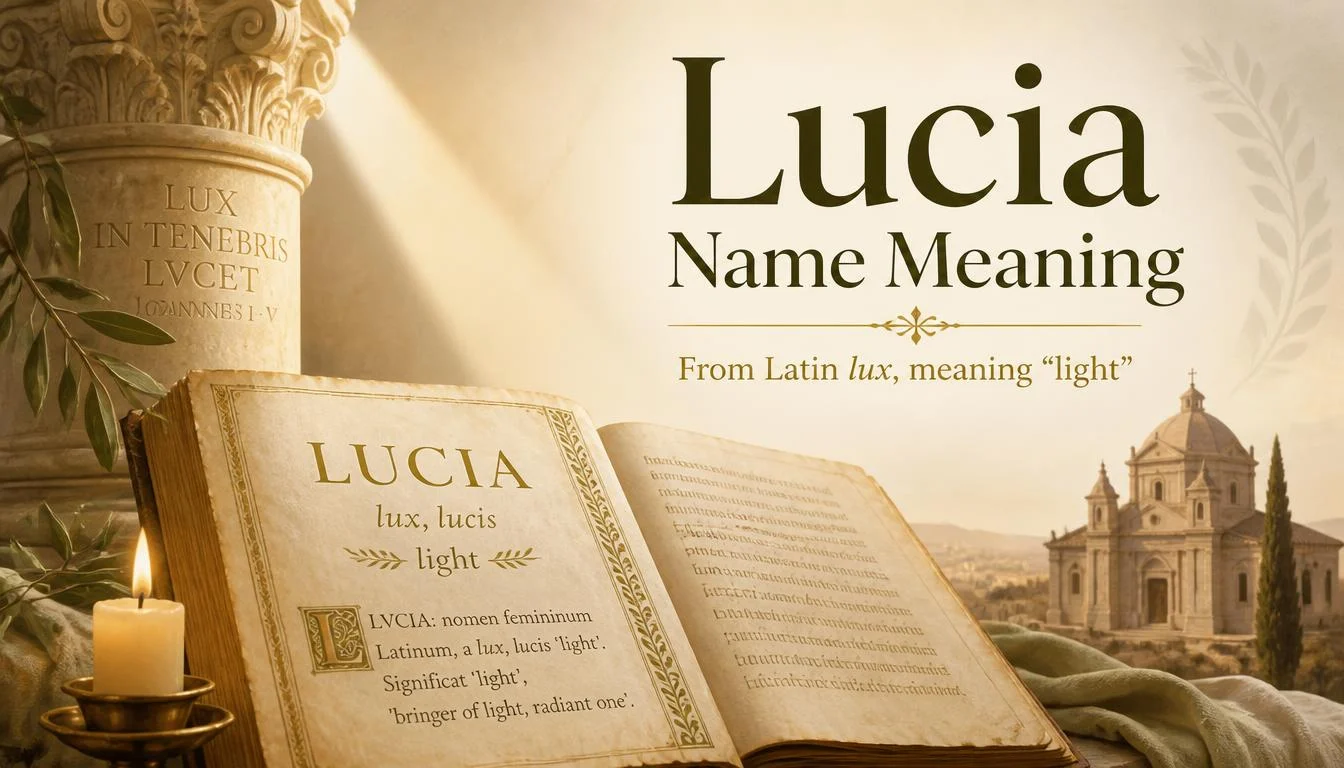
Lucia is a feminine name of Latin origin connected with lux, meaning “light.” It developed as the feminine form of Lucius and gained strong Christian associations through Saint Lucia of Syracuse.
The name Lucia has a graceful sound and a long history rooted in the Latin language. It comes from the Latin name Lucia, the feminine form of Lucius, which connects to lux, meaning “light.” Because of this origin, Lucia carries a meaning associated with brightness, illumination, and light. The name has remained familiar across generations and appears in several European languages and cultures, each adding its own pronunciation and character.
Lucia also has a strong historical and cultural presence, particularly through Christian tradition and European naming history. Its connection with light gives the name a warm and positive quality, while its long use gives it a classic character. In this guide, you’ll learn about the Lucia name meaning, its Latin origin, history, pronunciation, variations, cultural significance, and other useful details that can help you understand the name more fully.
Key Facts
| Fact | Details |
|---|---|
| Gender | Girl |
| Meaning | Light |
| Origin | Latin / Ancient Roman |
| Pronunciation | loo-CHEE-ah |
| Related Name | Lucius |
| Spanish Form | Lucía |
| Portuguese Form | Lúcia |
| English Related Form | Lucy |
| Religious Association | Saint Lucia of Syracuse |
What Is Lucia?
Lucia is a feminine given name that developed from the Roman name Lucius. Its core linguistic association comes from Latin lux, meaning “light.” The name appears in several European languages, including Italian, German, Dutch, English, Swedish, Norwegian, Danish, Romanian, and Slovak.
In everyday naming, Lucia can suggest brightness, illumination, or something associated with light. Those ideas come from the name’s linguistic root rather than from a separate modern definition.
Lucia should not be confused with every name that begins with Luc-. Some related names share the same Latin root, while others have different histories.
Lucia Name Meaning
The central meaning of Lucia is “light.” This meaning comes from the Latin root associated with lux, which also appears in the history of Lucius.
Literal Meaning: “Light”
The simplest explanation of Lucia is light. In a naming context, that can evoke brightness and illumination, but parents do not need to treat those ideas as fixed personality traits.
Names often acquire cultural associations beyond their original dictionary meanings. Lucia is a good example because its Latin meaning later gained religious significance through Saint Lucia.
Religious Meaning and Association
Saint Lucia, also called Saint Lucy, was a Christian martyr associated with Syracuse in Sicily and the persecution of Christians during the early fourth century. Her feast day falls on December 13.
Her story became especially influential in Christian Europe. Over time, Lucia and its related forms became associated with Saint Lucy’s remembrance and devotion. That religious history helped the name remain familiar long after its original Roman setting.
Origin and Etymology
Lucia has Latin and Ancient Roman roots. Linguistically, it is recognized as the feminine form of Lucius, a Roman given name derived from Latin lux, meaning “light.”
The connection between Lucia and Lucius gives the name a direct link to Roman naming traditions. Lucius itself was an established Roman praenomen, while Lucia developed as its feminine counterpart.
As Latin evolved into the Romance languages, related forms spread and changed according to local pronunciation and spelling. That process explains forms such as Lucía in Spanish and Lúcia in Portuguese.
History and Cultural Context
Lucia gained a major cultural association through Saint Lucia of Syracuse, a Christian martyr from Sicily. Sources agree that she lived during the early fourth century, although later accounts contain legendary elements that historians cannot treat as equally certain.
Her veneration spread beyond Syracuse and reached Rome by late antiquity. During the Middle Ages, Saint Lucia became widely revered, and the name circulated throughout Christian Europe in several forms.
The English form Lucy developed from Lucia and has been used since the Middle Ages. In England, Lucia itself appeared historically, while Lucy and Luce became more familiar English forms.
The name also remains closely connected with Italian culture. In Spanish-speaking settings, Lucía is the standard Spanish form, while Portuguese uses Lúcia. These spellings preserve the same basic naming family while reflecting different language systems.
Examples
Lucia works naturally as a first name in many naming styles.
- Lucia Marie has a classic, traditional sound.
- Lucia Rose combines the name with a short floral middle name.
- Lucia Elena gives the full name a distinctly Romance-language feel.
- Lucia Grace pairs its light-related meaning with another positive concept.
In English, pronunciation can vary. A common pronunciation is loo-CHEE-ah, while other languages use different vowel or consonant patterns. Italian, German, English, Romanian, and Latin pronunciations are not identical.
The Spanish spelling Lucía uses an accent mark, which helps indicate the pronunciation in Spanish. Portuguese uses Lúcia.
Variants and Spellings
Lucia has a particularly broad family of established forms.
| Language or tradition | Form |
|---|---|
| Italian | Lucia |
| Spanish | Lucía |
| Portuguese | Lúcia |
| Croatian / Slovene | Lucija |
| Polish | Łucja |
| French / Czech | Lucie |
| English | Lucy |
| Greek | Loukia |
| German | Luzia |
| Romanian | Lucia |
| Dutch | Lucia / Luus |
| Catalan | Llúcia |
These forms are documented as related versions rather than invented spelling alternatives.
Short forms and related diminutives include Luci, Lucica, Lucka, Lucetta, and Lucilla, depending on the language and naming tradition.
Luciana also belongs to the broader Latin-derived family, although it is a separate name rather than simply another spelling of Lucia.
Famous People Named Lucia
Several notable women have carried Lucia or the accented form Lucía.
- Lucia Popp Slovak operatic soprano whose career included performances at major opera houses such as the Vienna State Opera and Metropolitan Opera.
- Lucía Méndez Mexican actress and singer known for television, film, and music. Mexico’s cultural information system documents her career in acting and singing.
- Lucia Azzolina Italian politician and teacher who served as Italy’s Minister of Education from 2020 to 2021.
The name also appears in literature and opera. Lucia is the central character in Gaetano Donizetti’s Lucia di Lammermoor, which premiered in Naples in 1835.
Lucia vs. Related Terms
| Term | Meaning | How It Differs |
|---|---|---|
| Lucia | Light | Feminine form of Lucius |
| Lucius | Connected with light | Ancient Roman masculine name |
| Lucy | Light / form of Lucia | English form of Lucia |
| Lucía | Light | Spanish form with an accent |
| Lúcia | Light | Portuguese and Hungarian form |
| Lucija | Light | Croatian and Slovene form |
The shared idea of light links these names, but their spelling, pronunciation, and language history differ.
FAQs
1. What does the name Lucia mean?
Lucia means “light.” The meaning comes from its connection with the Latin lux and the Roman name Lucius.
2. What is the origin of Lucia?
Lucia has Latin and Ancient Roman origins. It developed as the feminine form of Lucius, a Roman name connected with Latin lux, meaning “light.”
3. How do you pronounce Lucia?
A common English pronunciation is loo-CHEE-ah. Pronunciation changes across languages, so Italian, Spanish, English, German, and Romanian speakers may pronounce the name differently.
4. Is Lucia a biblical name?
Lucia does not originate as a biblical name. Its roots are Roman and Latin. However, the name gained an important Christian association through Saint Lucia of Syracuse.
5. Is Lucia the same as Lucy?
Lucia and Lucy belong to the same naming family. Lucy is the English form of Lucia, and it has been used in English since the Middle Ages.
6. What is the Spanish version of Lucia?
The Spanish form is Lucía, written with an accent over the final i. Other related forms include Portuguese Lúcia and Croatian or Slovene Lucija.
7. Who was Saint Lucia?
Saint Lucia was a Christian martyr associated with Syracuse in Sicily who died during the persecution of Christians in the early fourth century. Her feast day is December 13, and she became widely venerated in Christian Europe.
Conclusion
Lucia is a classic feminine name with a clear Latin connection to “light.” Its Roman roots, association with Saint Lucia, and many European forms give it a history that reaches across languages and centuries. For parents considering Lucia today, the name combines a simple meaning with a rich cultural background.
Read More Articles
- Alyssa Name Meaning | History, Roots and Cultural Significance In 2026
- Molly Name Meaning | Origins, Personality and Cultural Significance In 2026











2 thoughts on “Lucia Name Meaning |Origin, History and What the Name Represents In 2026”