Quick Answer
Lydia means “woman from Lydia,” referring to an ancient kingdom in Asia Minor. The name carries both geographic and biblical significance.
The Lydia name meaning carries a connection to the ancient region of Lydia in Asia Minor, giving this elegant name a rich historical background. Traditionally associated with Greek usage and the ancient place name Lydia, it has endured for centuries while maintaining a graceful, classic feel. The name also has a notable biblical connection through Lydia of Thyatira, a woman mentioned in the New Testament who is remembered as an early follower of Christianity.
Beyond its ancient roots, Lydia has remained appealing because of its refined sound, historical depth, and strong cultural associations. Parents exploring the name often appreciate how it combines an old-world heritage with a style that still feels natural today. In this guide, we’ll explore the Lydia name meaning, its origin, history, pronunciation, biblical connection, popularity, personality associations, and other details that can help you understand the name more fully.
Key Facts Box
| Fact | Detail |
|---|---|
| Gender | Girl |
| Meaning | “Woman from Lydia” |
| Origin | Greek, geographic |
| Pronunciation | LID-ee-ə |
| Related Region | Ancient Lydia, in modern-day Turkey |
What Is Lydia?
Lydia functions as a feminine given name that started life as a geographic descriptor rather than a name created around a specific meaning or virtue. Ancient Greek speakers used it simply to describe someone from the region of Lydia.
Unlike names built from abstract concepts like light or wisdom, Lydia ties directly to a real place with a documented ancient history, giving the name a grounded, historical character that many other names lack.
Lydia Meaning
Lydia means “woman from Lydia,” a straightforward geographic meaning tied to the ancient kingdom of the same name. Greek speakers formed the name the way many ancient cultures identified people by their place of origin.
Because this meaning rests on solid historical and geographic evidence rather than uncertain linguistic reconstruction, name references rarely dispute Lydia’s core translation.
Modern parents typically choose Lydia for its graceful, classic sound rather than a direct interest in ancient Anatolian geography, though the name’s historical weight still adds meaningful depth for those who explore its background.
Origin and Etymology
Lydia takes its name directly from the ancient kingdom of Lydia, located in what is now western Turkey. This wealthy and influential kingdom flourished particularly during the 7th and 6th centuries BCE, reaching its height under King Croesus, famous throughout history for his immense wealth.
Ancient Greek writers used “Lydia” both as the region’s name and, by extension, as a personal name for women associated with or originating from that area. This naming pattern reflects a broader ancient tradition of using place names as personal names.
Because this etymology traces directly to documented ancient history rather than reconstructed linguistic roots, Lydia’s origin carries strong historical grounding.
History and Cultural Context
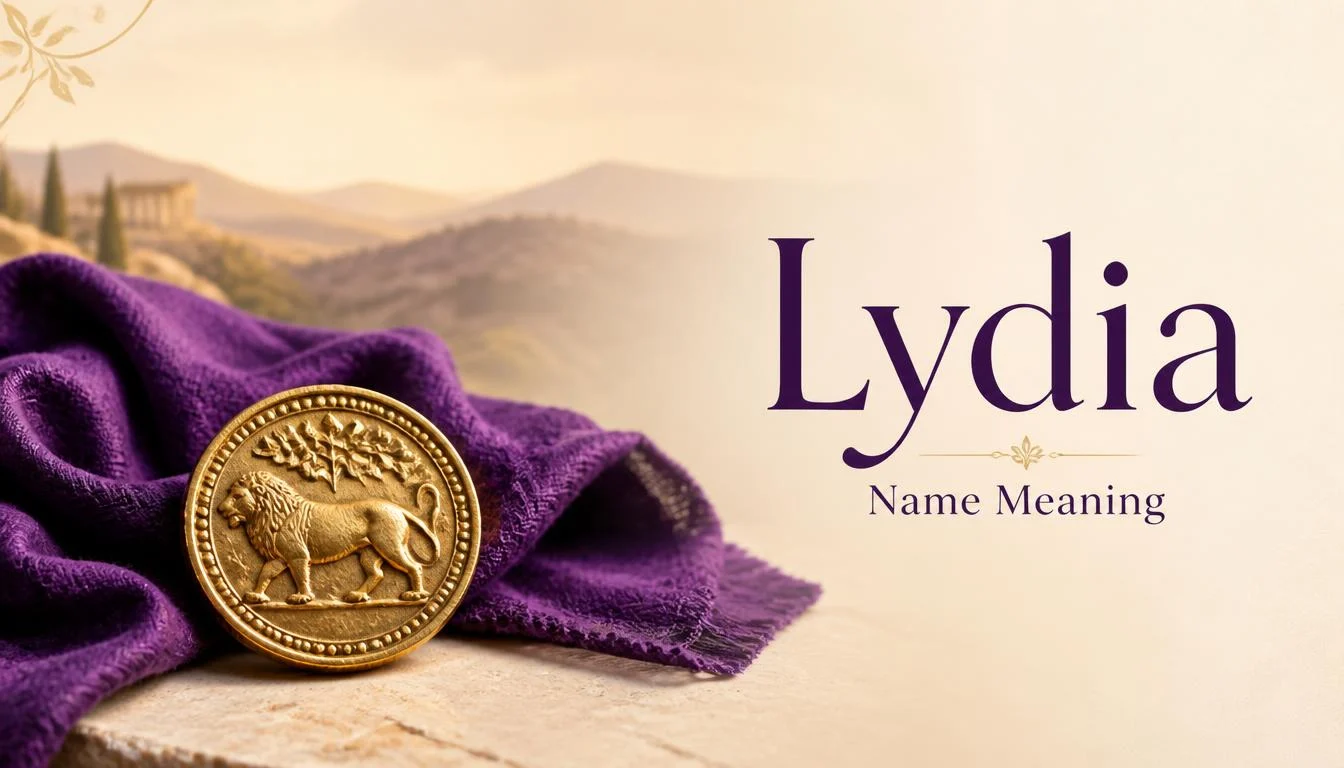
Ancient Lydia holds a significant place in world history as the region credited with minting some of the earliest known coins, a development that transformed trade and commerce throughout the ancient Mediterranean world.
The name gained additional significance through Lydia of Thyatira, mentioned in the New Testament Book of Acts as a merchant of purple cloth and one of the apostle Paul’s early converts in Philippi. This biblical mention helped spread the name across Christian communities for centuries afterward.
Lydia remained a respected, classic name throughout European history and gained particular popularity during the 19th century, part of a broader Victorian-era trend toward names with ancient Greek and biblical roots.
Examples
Seeing the name in everyday context helps show how naturally it fits modern usage:
- “They chose the name Lydia for its graceful, ancient history.”
- “Lydia organized her books carefully on the new shelf.”
- A birth announcement reads: “Welcome, Lydia Grace — born January 30th.”
- A wedding invitation reads: “Miss Lydia Anne Whitmore requests the pleasure of your company.”
These examples show the name working comfortably across formal, personal, and everyday settings.
Variants and Spellings
Lydia connects to several genuine variants across languages:
- Lidia a common spelling in Spanish, Italian, and Polish.
- Lydie the French form of the name.
- Lyddie an informal nickname variant.
These forms reflect genuine regional spelling differences rather than invented alternatives.
Famous People Named Lydia
- Lydia Ko New Zealand professional golfer and former world number one.
- Lydia Davis American short story writer and translator known for her concise fiction.
- Lydia of Thyatira biblical figure mentioned in the New Testament as one of Paul’s early converts and a merchant of purple cloth.
Lydia vs. Related Terms
| Term | Meaning | How It Differs |
|---|---|---|
| Lydia | “Woman from Lydia” | The Greek geographic name still used today |
| Lydian | Relating to ancient Lydia | An adjective describing the region, not a personal name |
| Lidia | “Woman from Lydia” | A spelling variant common in Spanish, Italian, and Polish |
| Croesus | Not directly related in meaning | The most famous king of ancient Lydia, known for his wealth |
FAQS
What does the name Lydia mean?
Lydia means “woman from Lydia,” referring to the ancient kingdom located in western Asia Minor.
Is Lydia a biblical name?
Yes, Lydia appears in the New Testament Book of Acts as a merchant and one of the apostle Paul’s early converts.
Where was ancient Lydia located?
Ancient Lydia occupied territory in what is now western Turkey and flourished as a wealthy, influential kingdom around the 7th and 6th centuries BCE.
Is Lydia a common name today?
Yes, Lydia remains a well-used, classic name across English-speaking and European countries.
What is the male version of Lydia?
There isn’t a widely recognized traditional male equivalent, since the name developed specifically to describe women from the region.
How do you pronounce Lydia?
Most English speakers pronounce Lydia as LID-ee-ə, with stress on the first syllable.
What are common nicknames for Lydia?
Liddy and Lyddie occasionally appear as informal nicknames for people named Lydia.
Conclusion
Lydia carries a distinctive geographic meaning, tracing back to the wealthy ancient kingdom that once flourished in western Asia Minor. Its biblical connection through Lydia of Thyatira added lasting religious significance well beyond its original geographic use. Whether parents choose it for its ancient history or its graceful, classic sound, Lydia continues to hold enduring appeal.
Read More Articles
- Brielle Name Meaning | History, Cultural Roots and Personality In 2026
- Penelope Name Meaning|History, Popularity and Personality In 2026











1 thought on “Lydia Name Meaning | From Ancient Lydia to a Modern Girl’s Name In 2026”