Quick Answer
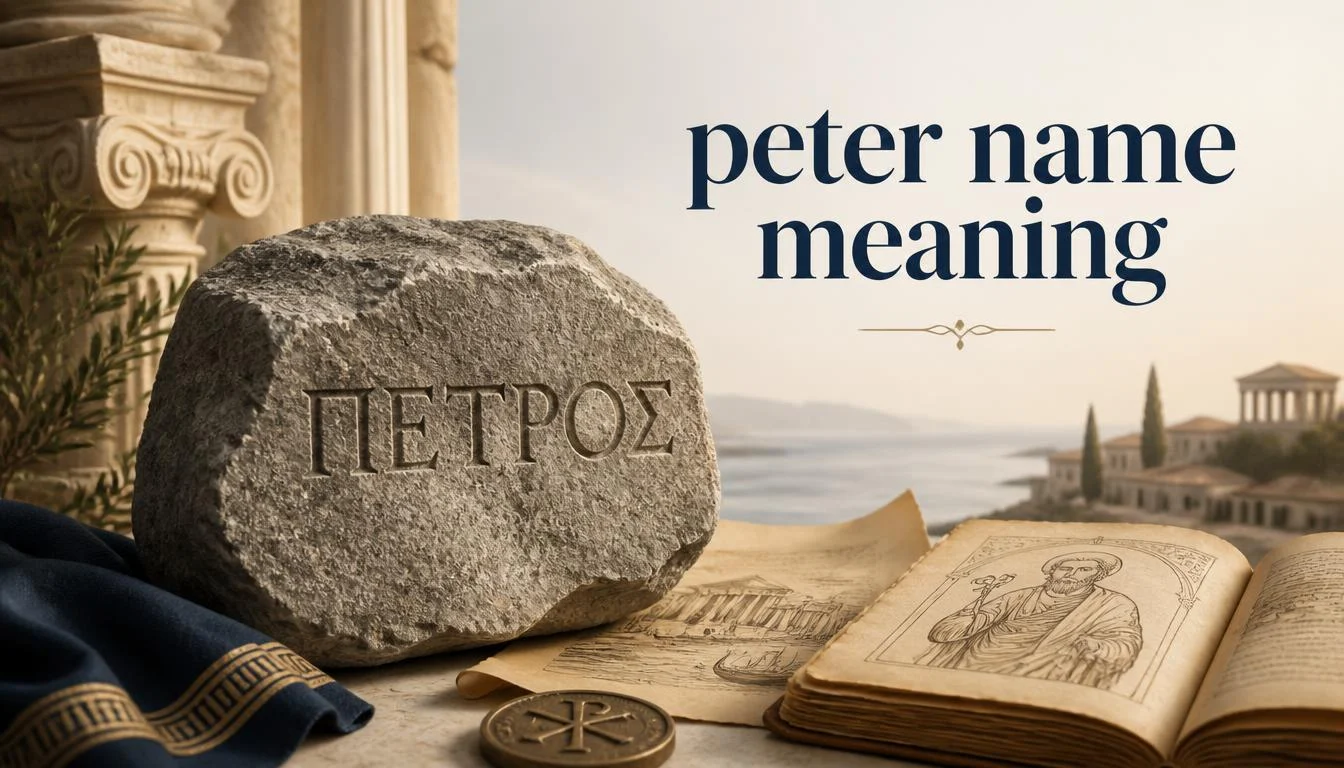
Peter means “stone” or “rock” and comes from the Greek name Petros. It has Biblical roots through Simon Peter, whose name connects the Greek Petros with the Aramaic Cephas, meaning “rock.”
The Peter name meaning has deep roots in ancient Greek and Christian history. Peter comes from the Greek name Petros, which means “stone” or “rock.” The name gained lasting recognition through the New Testament, where Jesus gave the apostle Simon the name Peter, connecting it with the image of a rock. This biblical connection helped the name spread across many languages and cultures over the centuries.
Today, Peter remains a familiar classic name with a long history of religious, cultural, and literary use. Its simple sound and strong meaning have helped it remain recognizable across generations. If you are exploring the Peter name meaning, this guide covers its origin, biblical background, pronunciation, variations, symbolism, and historical significance to give you a clear picture of this enduring name.
Key Facts
| Fact | Details |
|---|---|
| Gender | Boy / Masculine |
| Meaning | “Stone” or “rock” |
| Origin | Greek, with Biblical and Aramaic connections |
| Pronunciation | PEE-ter |
| Biblical connection | Simon Peter, one of Jesus’ apostles |
| Common short form | Pete |
What Is Peter?
Peter is a masculine given name with Greek and Biblical roots. Its original Greek form is Πέτρος (Petros), which means “stone.” In the New Testament, Petros represents the name given to Simon, one of Jesus’ apostles.
The name also connects with Cephas, an Aramaic name meaning “rock.” Biblical accounts present Cephas as another name for Simon Peter, while Greek versions use Petros. That connection explains why “rock” and “stone” both appear in explanations of Peter’s meaning.
Peter therefore carries more than a literal reference to a physical stone. Within Christian tradition, the word gained symbolic associations with firmness, stability, and strength because of its Biblical context.
Peter Name Meaning
The central meaning of Peter is “stone” or “rock.” The Greek Petros provides the direct linguistic source.
Traditional Meaning
In its original linguistic sense, Peter refers to a stone or rock. That meaning gives the name a simple, solid quality rather than an abstract or decorative definition.
The Biblical association adds another layer. Jesus refers to Simon as Peter in the Gospel tradition, connecting the name with the image of a rock. Because of this history, many people associate Peter with ideas such as steadiness, strength, and reliability.
Those qualities describe cultural associations rather than additional dictionary meanings. The established etymological meaning remains “stone” or “rock.”
Biblical Meaning
Peter has a particularly strong place in Christianity because Simon Peter appears prominently among Jesus’ apostles. The New Testament uses both the Greek Petros and the Aramaic Cephas in connection with him.
That Biblical connection helped the name spread throughout the Christian world. Over time, Peter became established in many European languages, each developing its own form.
Origin and Etymology
Peter ultimately comes from Ancient Greek Πέτρος (Petros), meaning “stone.” The name represents the Greek form associated with the Aramaic Cephas, which also means “rock.”
The linguistic path becomes especially interesting in the New Testament. Simon, a Jewish fisherman who became one of Jesus’ leading apostles, received the name Cephas in Aramaic. Greek-speaking Christian texts use Petros, which became Peter in English.
Latin preserved the name as Petrus, and European languages later developed their own forms. English eventually settled on Peter, while French developed Pierre, Spanish Pedro, and Italian Pietro.
The English form also has a medieval history. Norman influence brought the related Old French form Piers to England, while Peter became increasingly established as the standard English spelling.
History and Cultural Context
Peter’s history begins with its Biblical association, but its influence extends far beyond the New Testament. The name became common across Christian Europe because of the prominence of Simon Peter and later Christian saints named Peter.
Several important religious figures carried the name. Examples include Saint Peter Damian, an 11th-century reformer, and Saint Peter Martyr, a 13th-century preacher. Their lives helped maintain the name’s importance within European Christian communities.
The name also reached royal families. Peter the Great, born Pyotr Alekseyevich, ruled Russia during the late 17th and early 18th centuries and became emperor in 1721. Britannica describes his reign as a period of major governmental, military, and institutional reform.
As Christianity expanded across different European societies, local languages adapted Peter into their own forms. That explains why someone named Pedro in Spain, Pietro in Italy, or Piotr in Poland can have the same historical name root.
Examples
Peter works naturally in several naming contexts:
- Peter James a traditional first and middle name combination.
- Peter Alexander a formal combination with a classic sound.
- Peter Williams a familiar English language name structure.
- Pete a common informal short form of Peter.
- Simon Peter the Biblical form associated with the apostle.
In ordinary English conversation, Peter usually functions as a formal given name, while Pete can create a more relaxed tone.
The name also appears in literature and popular culture. Peter Rabbit, created by Beatrix Potter, and Peter Pan, created by J. M. Barrie, are two especially recognizable fictional examples. Peter Parker is the civilian name of the superhero Spider Man.
Variants and Spellings
Peter has numerous established forms across languages. They reflect pronunciation and spelling traditions rather than completely different names.
| Language / Region | Form |
|---|---|
| English | Peter |
| Greek | Petros |
| German | Peter |
| Dutch | Pieter |
| French | Pierre |
| Spanish | Pedro |
| Italian | Pietro |
| Portuguese | Pedro |
| Polish | Piotr |
| Russian | Pyotr |
| Ukrainian | Petro |
| Czech | Petr |
| Croatian / Serbian | Petar |
| Hungarian | Péter |
| Romanian | Petre / Petru |
| Scandinavian | Per / Peder / Petter |
| Arabic | Botros / Boutros / Butrus |
The short form Pete is common in English. Other languages have their own diminutives, such as Piotrek in Polish and Peťa in Czech.
The feminine counterpart Petra also developed in several European languages. It shares the same underlying name family and ultimately connects with the same Greek root.
Famous People Named Peter
- Peter the Great (1672–1725) Russian ruler who became emperor in 1721 and introduced major reforms to Russia.
- Peter Sellers (1925–1980) English actor and comedian known internationally for roles including Inspector Clouseau in The Pink Panther films.
- Peter Gabriel (born 1950) English singer-songwriter and former Genesis frontman who later developed a major solo career.
- Peter Capaldi (born 1958) Scottish actor and director known for playing the Twelfth Doctor in Doctor Who.
These examples show how the name appears across politics, entertainment, music, and television without changing its underlying linguistic meaning.
Peter vs. Related Terms
| Term | Meaning | How It Differs |
|---|---|---|
| Peter | “Stone” or “rock” | English form of the name from Greek Petros |
| Petros | “Stone” | Greek form and direct linguistic source of Peter |
| Cephas | “Rock” | Aramaic name associated with Simon Peter |
| Pierre | French form of Peter | French-language equivalent |
| Pedro | Spanish/Portuguese form of Peter | Romance-language form |
| Pietro | Italian form of Peter | Italian-language form |
| Petra | Feminine form related to Peter | Feminine name in several European languages |
FAQs
1. What does the name Peter mean?
Peter means “stone” or “rock.” The name comes from Greek Petros and gained major Biblical significance through Simon Peter.
2. Is Peter a Biblical name?
Yes. Peter is a Biblical name associated with Simon Peter, one of Jesus’ apostles. The Greek form Petros connects with the Aramaic Cephas, meaning “rock.”
3. What is the origin of the name Peter?
Peter has Greek origin, specifically from Petros. Its Biblical history also connects it with the Aramaic name Cephas.
4. Is Peter a boy’s name or a unisex name?
Peter is traditionally a masculine name. Petra developed as a related feminine form in several languages.
5. What is the nickname for Peter?
Pete is the most familiar English short form of Peter. Other languages use different diminutives and shortened forms.
6. What are the international forms of Peter?
Common forms include Pierre in French, Pedro in Spanish and Portuguese, Pietro in Italian, Piotr in Polish, Pyotr in Russian, and Petar in several South Slavic languages.
7. How do you pronounce Peter?
In standard English, Peter is commonly pronounced PEE-ter. The exact vowel and final sound can vary slightly between English accents.
Conclusion
Peter means “stone” or “rock” and traces its history to the Greek Petros, with a strong Biblical connection to Simon Peter. Its long use across Europe produced forms such as Pierre, Pedro, Pietro, and Piotr. The name remains recognizable for its simple meaning and deep historical roots.
Read More Articles
- Vanessa Name Meaning | Origin, Pronunciation and Name Facts In 2026
- August Name Meaning | History, Meaning, Pronunciation and More In 2026











1 thought on “Peter Name Meaning | History, Roots, Pronunciation and More In 2026”