Quick Answer
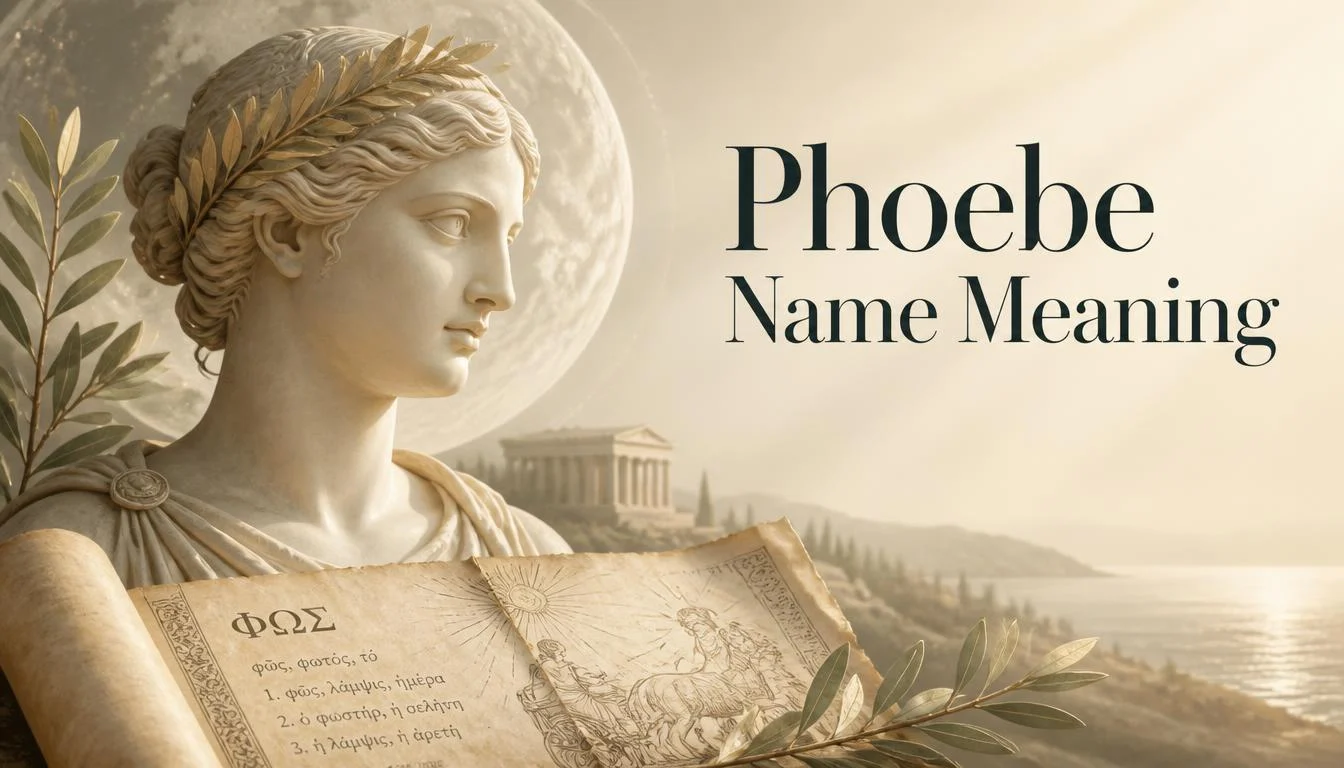
Phoebe means “bright” or “pure” and comes from the Ancient Greek name Phoibe, from phoibos. The name has strong Greek mythological and biblical connections and has long been used as a feminine given name.
The Phoebe name meaning has roots in ancient Greek and is commonly associated with ideas such as “bright,” “radiant,” and “pure.” The name comes from the Greek word phoibos, which carries the sense of brightness or brilliance. Phoebe also has a long history in Greek mythology and early Christian tradition, giving it both classical and biblical significance. Its elegant sound and rich background have helped the name remain recognizable across generations.
Phoebe combines a graceful style with a history that reaches back to the ancient world. In Greek mythology, Phoebe was associated with the Titans, while the New Testament mentions a Christian woman named Phoebe who served the early church at Cenchreae. These historical and cultural connections give the name more depth than its gentle sound might suggest. Today, Phoebe appeals to parents looking for a traditional name with a distinctive character, meaningful history, and timeless charm.
Key Facts
| Feature | Details |
|---|---|
| Gender | Girl / Feminine |
| Meaning | Bright, pure |
| Origin | Ancient Greek |
| Greek Form | Phoibe (Φοίβη) |
| Pronunciation | FEE-bee |
| Biblical Connection | Phoebe, a woman mentioned by Paul in Romans |
| Mythological Connection | Phoibe, a Titan associated with the moon |
What Is Phoebe?
Phoebe is a feminine given name with Ancient Greek roots. The original Greek form is Phoibe, written Φοίβη, while Phoebe represents its Latinized form and later English usage. The name derives from phoibos, a Greek word associated with brightness and purity.
In English, Phoebe is usually pronounced FEE-bee. Its two-syllable rhythm makes the name easy to recognize, while the spelling gives it a distinctly classical appearance.
Phoebe differs from names that simply sound similar because its history reaches back to an attested Greek form. It also has both mythological and biblical significance, giving it more than one established cultural association.
Phoebe Name Meaning
The central meaning of Phoebe is “bright” or “pure.” These meanings come from the Greek phoibos, the root associated with the name.
Bright
“Bright” is the most direct modern gloss for the Greek root. The word can suggest radiance, clarity, or something that shines. That association fits naturally with Phoebe’s later links to lunar imagery and Apollo-related Greek terminology.
The masculine Greek name Phoibos, the source of the Latinized Phoebus, also carries the meanings “bright” and “pure.” Phoebus served as an epithet of Apollo.
Pure
“Pure” provides the second traditional interpretation. Rather than describing a personality trait that every person named Phoebe must possess, it represents the established lexical meaning connected with the Greek root.
For parents choosing the name today, the combination of “bright” and “pure” often gives Phoebe a gentle but distinctive character.
Origin and Etymology
Phoebe traces to the Ancient Greek Phoibe (Φοίβη). Greek phoibos provides the underlying word and means “bright” or “pure.” The English form developed through the Latinized Phoebe rather than directly preserving the Ancient Greek spelling.
The name belongs to the same linguistic family as Phoibos/Phoebus, the masculine form associated with Apollo. In Greek mythology, Phoibe and Phoibos functioned as names or epithets connected with brightness.
The Greek form Phoibe remains important when discussing the ancient name. Modern English Phoebe reflects the form that became established in English-language naming traditions.
History and Cultural Context
Phoebe has two especially notable historical connections: Greek mythology and Christianity.
In Greek mythology, Phoibe was a Titan associated with the moon. The name also served as an epithet of her granddaughter, Artemis, a goddess strongly associated with the moon. This gives Phoebe a longstanding lunar association, although “moon” is better treated as a cultural association than as the literal dictionary meaning of the name.
The name also appears in the New Testament. Paul refers to Phoebe in his Epistle to the Romans and identifies her with the Christian community at Cenchreae. This biblical appearance helped preserve the name beyond the classical Greek world.
English speakers later adopted Phoebe as a given name. Records cited by name historians place its English use after the Protestant Reformation, and the name saw notable use during the nineteenth century.
Its cultural visibility increased again in modern popular culture. The television series Friends featured the character Phoebe Buffay, while Charmed also included a prominent character named Phoebe. These appearances helped keep the name familiar to English-speaking audiences.
Examples of Phoebe in Use
Phoebe works naturally as a first name in several naming styles:
- Phoebe Grace a classic first name paired with a familiar middle name.
- Phoebe Rose combines the Greek rooted name with a floral middle name.
- Phoebe Jane gives the traditional name a simple, timeless pairing.
- Phoebe Elizabeth creates a strongly traditional full-name combination.
In everyday speech, someone might say:
- “Phoebe starts school this fall.”
- “I met Phoebe at the library.”
- “Phoebe was named after her grandmother.”
The pronunciation remains straightforward: FEE-bee.
Variants and Spellings
Several genuine forms of Phoebe appear across languages and historical traditions.
| Form | Language or Tradition | Relationship |
|---|---|---|
| Phoebe | English, Biblical Latin | Standard English form |
| Phoibe | Ancient Greek | Original Greek form |
| Phebe | Biblical / English | Historical variant |
| Pheobe | English | Spelling variant |
| Febe | Dutch, Italian, Portuguese, Spanish | European form |
| Phoebus | Latinized Greek | Masculine related form |
Phoibe is the ancient Greek form, while Phoebe became the established English form. Phebe appears as an established biblical and historical spelling, rather than simply being a modern misspelling.
Famous People Named Phoebe
Several well-known women have carried the name Phoebe.
- Phoebe Waller-Bridge English actor, writer, producer, and creator known for Fleabag and Killing Eve.
- Phoebe Bridgers American singer songwriter and musician known for her solo work and collaborations.
- Phoebe Cates American former actress and model known for films including Fast Times at Ridgemont High.
- Phoebe Snow American singer songwriter known for her distinctive vocal style and recordings.
- Phoebe Dynevor English actress known internationally for television and film roles.
The name also belongs to Phoebe in the New Testament, making its historical significance much older than its modern celebrity associations.
Phoebe vs. Related Terms
| Term | Meaning | How It Differs |
|---|---|---|
| Phoebe | Bright, pure | English feminine form derived from Greek Phoibe |
| Phoibe | Bright, pure | Ancient Greek form of Phoebe |
| Phoebus | Bright, pure | Masculine related form and epithet associated with Apollo |
| Phebe | Variant form of Phoebe | Historical/biblical spelling variant |
| Artemis | Greek goddess associated with the moon and other domains | Connected to Phoebe through mythology, but it is a separate name |
The relationship between Phoebe and Artemis deserves care. Phoibe was a Titan associated with the moon, and Phoibe also served as an epithet of Artemis. That connection does not make the two names interchangeable.
FAQs
Is Phoebe a Greek name?
Yes. Phoebe comes from the Ancient Greek Phoibe (Φοίβη). The English form represents the Latinized version of the Greek name.
What does the name Phoebe mean?
Phoebe traditionally means “bright” or “pure.” The meaning comes from the Greek word phoibos.
Is Phoebe a biblical name?
Yes. Phoebe appears in the New Testament in Paul’s Epistle to the Romans. The name belongs to a woman associated with the Christian community at Cenchreae.
Is Phoebe connected to the moon?
Yes, through Greek mythology. Phoibe was a Titan associated with the moon, and Phoibe was also used as an epithet for Artemis. The lunar connection is cultural and mythological rather than the literal meaning of the name.
How do you pronounce Phoebe?
Phoebe is commonly pronounced FEE-bee in English. It has two syllables, with the first syllable receiving the main stress.
Is Phoebe a girl’s name?
Yes. Phoebe is traditionally a feminine given name. Established sources classify its English and Greek usage as feminine.
What are the variants of Phoebe?
Established forms include Phoibe, Phebe, Pheobe, and Febe. Phoibe represents the Ancient Greek form, while Febe appears in several European languages.
Is Phoebe an old-fashioned name?
Phoebe has ancient roots, but the name does not belong exclusively to one historical period. It has appeared in Greek mythology, the New Testament, English naming traditions, and modern popular culture. That long continuity gives it a classical character without limiting it to a particular era.
Conclusion
Phoebe is a feminine name of Ancient Greek origin meaning “bright” or “pure.” Its history connects the name with Greek mythology, lunar symbolism, and the New Testament, while its modern use keeps the traditional form familiar. For parents seeking a classic name with clear historical depth, Phoebe carries a concise meaning and a remarkably broad cultural history.
Read More Articles
- Eric Name Meaning | Origin, Meaning, Pronunciation and More In 2026
- Zion Name Meaning |Origin, History and Significance In 2026










