Quick Answer
Cecilia is a feminine name of Latin and Ancient Roman origin, derived from the Roman family name Caecilius, ultimately linked to Latin caecus, meaning “blind.” The name also carries a strong Christian association through Saint Cecilia, the traditional patron saint of music and musicians.
The name Cecilia has a graceful, timeless quality that has kept it popular across generations. It comes from the ancient Roman family name Caecilius, which traces back to the Latin word caecus, meaning “blind.” Although its original literal meaning may seem unusual, Cecilia gained a much richer cultural identity through its long history, particularly through Saint Cecilia, the Christian patron saint of music. The name has since become associated with elegance, tradition, and artistic heritage.
Today, Cecilia appeals to parents who want a classic name with deep historical roots and a refined sound. Its use across different languages and cultures has also produced familiar forms such as Cecile, Cécile, and Cecelia. In this guide, we’ll explore the Cecilia name meaning, its Latin and Roman origins, historical background, pronunciation, popularity, variations, and the cultural associations that have shaped this enduring name.
Key Facts Box
| Detail | Information |
|---|---|
| Gender | Girl / Feminine |
| Meaning | “Blind,” from Latin caecus |
| Origin | Latin; Ancient Roman |
| Pronunciation | seh-SEEL-ee-uh |
| Original Form | Caecilia |
| Related Name | Cecily |
| Religious Association | Saint Cecilia and Christian tradition |
| Name Day | November 22 in several European traditions |
What Is Cecilia?
Cecilia is a feminine given name with roots in the ancient Roman name Caecilia. Linguistically, it belongs to the same family as Caecilius, an old Roman family name derived from the Latin adjective caecus, “blind.” The name existed before Christianity, so its original meaning should not be confused with the later religious symbolism attached to Saint Cecilia.
In modern naming, Cecilia usually functions as a traditional feminine first name rather than as a word whose literal meaning people actively use. Its historical depth, elegant sound, and association with Saint Cecilia have helped it remain recognizable across generations.
Cecilia Meaning
Literal Meaning
The traditional etymological meaning of Cecilia is “blind.” The name developed from Caecilia, the feminine form of Caecilius, which itself connects to Latin caecus.
This meaning describes the linguistic origin of the name rather than a characteristic that parents expect a child named Cecilia to possess. Ancient names often developed from physical descriptions, occupations, places, family names, or nicknames.
Cultural Meaning
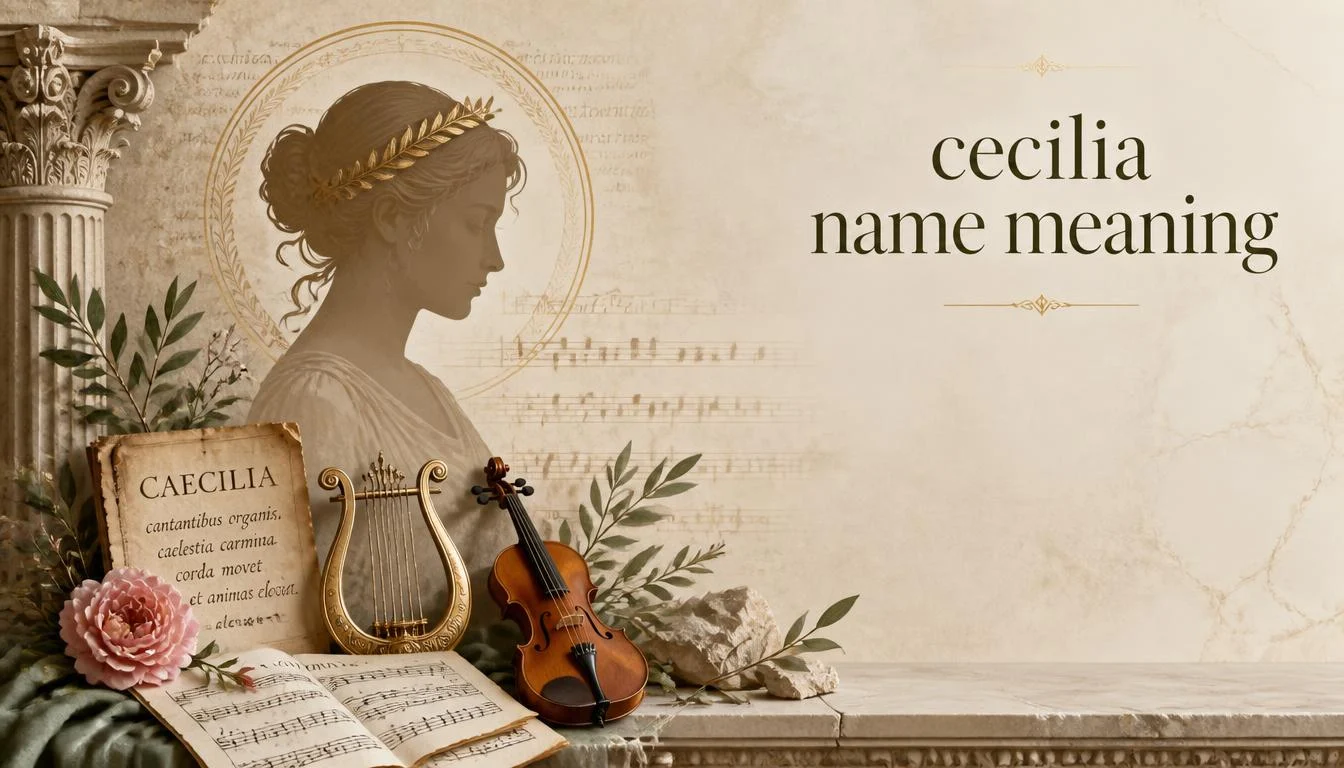
Cecilia gained an additional layer of meaning through Saint Cecilia, a Christian martyr associated with music and musicians. Her story became influential in Christian tradition, and her name helped spread Cecilia throughout Europe.
As a result, modern readers may associate Cecilia with music, artistic expression, devotion, and classical elegance. Those associations are cultural rather than the literal Latin meaning.
Origin and Etymology
Cecilia ultimately comes from the Ancient Roman form Caecilia. The masculine counterpart was Caecilius, a Roman family name connected with Latin caecus, meaning “blind.”
The original Latin spelling was Caecilia. Over time, different languages developed their own forms. English eventually used Cecilia alongside forms such as Cecily and Cecelia, while French uses Cécile and Cécilia, and Italian and Spanish retain Cecilia.
This history makes Cecilia a good example of how an ancient Roman family name can develop into a widely recognized modern given name.
History and Cultural Context
Saint Cecilia played a major role in the name’s later European history. She is traditionally described as a Christian martyr from the 2nd or 3rd century, and Christian tradition eventually associated her with music and musicians.
Her popularity helped establish Cecilia in Christian communities during the Middle Ages. The Normans brought the name to England, where Cecily became the more usual medieval English form. The Latinate Cecilia returned to wider English use later, including through literature.
Literature contributed another important chapter. Frances Burney used Cecilia for the title character of her 1782 novel Cecilia, or Memoirs of an Heiress. That literary use helped reinforce the name within English cultural history.
Examples
Cecilia works naturally in both traditional and modern naming settings.
- Cecilia Marie has a formal, classic sound.
- Cecilia Rose combines the traditional name with a short floral middle name.
- Cecilia Grace creates a familiar two name combination.
- Cece can work as an affectionate nickname.
- “Cecilia is learning to play the violin” shows the name in an everyday sentence.
The name also fits families interested in Roman history, European naming traditions, classical literature, or musical heritage.
Variants and Spellings
Cecilia has developed many genuine forms across languages and regions.
| Language / Tradition | Form |
|---|---|
| Ancient Roman / Latin | Caecilia |
| English | Cecilia, Cecily, Cecelia |
| French | Cécile, Cécilia |
| Italian | Cecilia |
| Spanish | Cecilia |
| Portuguese | Cecília |
| German | Cäcilia, Cäcilie |
| Polish | Cecylia |
| Catalan | Cecília |
| Croatian | Cecilija |
| Hungarian | Cecília |
| Swedish | Cecilia |
| Danish | Cecilia, Cecilie |
| Norwegian | Cecilia, Cecilie |
| Romanian | Cecilia |
Common English diminutives include Cece, Cissy, Sissie, and Sissy. Celia can sometimes serve as a shortened form, although it also exists independently as a name.
Famous People Named Cecilia
Several notable women have carried the name Cecilia.
- Cecilia Payne-Gaposchkin (1900–1979) was a British-American astronomer whose research established important knowledge about the chemical composition of stars. Harvard records her as a pioneer in astrophysics and a leading authority on variable stars.
- Cecilia Bartoli is an Italian mezzo-soprano known internationally for her performances and recordings in opera and classical music.
- Cecilia Vicuña is a Chilean artist and poet whose work spans visual art, poetry, installation, and environmental themes.
Cecilia vs. Related Terms
| Term | Meaning | How It Differs |
|---|---|---|
| Cecilia | Feminine form linked to Roman Caecilius | Modern international form |
| Caecilia | Original Latin feminine form | Older Classical Latin spelling |
| Cecily | English form of Cecilia | Medieval English development |
| Cecelia | Variant spelling of Cecilia | Same name family with an altered spelling |
| Cécile | French form | French-language equivalent |
| Cecília | Portuguese and several other language forms | Uses an accented spelling |
FAQs
What does the name Cecilia mean?
Cecilia traditionally means “blind.” It comes through the Latin Caecilia and the Roman family name Caecilius, which connects to Latin caecus.
Is Cecilia a biblical name?
Cecilia does not originate as a biblical name. Its roots are Ancient Roman and Latin. Its strong Christian connection comes from Saint Cecilia, a revered early Christian martyr.
What is the origin of the name Cecilia?
Cecilia has Latin and Ancient Roman origins. It developed from Caecilia, the feminine form of Caecilius, a Roman family name associated with Latin caecus, “blind.”
How do you pronounce Cecilia?
In common English pronunciation, Cecilia is pronounced seh-SEEL-ee-uh. The exact pronunciation changes somewhat across languages.
What is the nickname for Cecilia?
Common nicknames include Cece, Cissy, Sissie, and Sissy. In some contexts, Celia and Cilla can also appear as shortened or related forms.
Is Cecilia a girl’s name?
Yes. Cecilia is traditionally a feminine given name. Its masculine historical counterpart is Caecilius, with related modern forms including Cecil and Cecilio.
Why is Cecilia associated with music?
The association comes from Saint Cecilia, who became recognized as the patron saint of music and musicians in Christian tradition. This religious connection gave the name a lasting musical and artistic identity.
Conclusion
Cecilia is an ancient feminine name with a clear Latin and Roman foundation, tracing back to Caecilius and caecus, meaning “blind.” Its history extends far beyond that literal meaning, especially through Saint Cecilia and her connection with music. With forms such as Cecily, Cécile, and Cecília, the name has also developed a broad international presence.
Read More Articles
- Rebecca Name Meaning | Biblical Origin, History and Symbolism In 2026
- Ariel Name Meaning | Origin, History and Symbolism In 2026











1 thought on “Cecilia Name Meaning | Origins, Personality and Cultural Significance In 2026”