Quick Answer
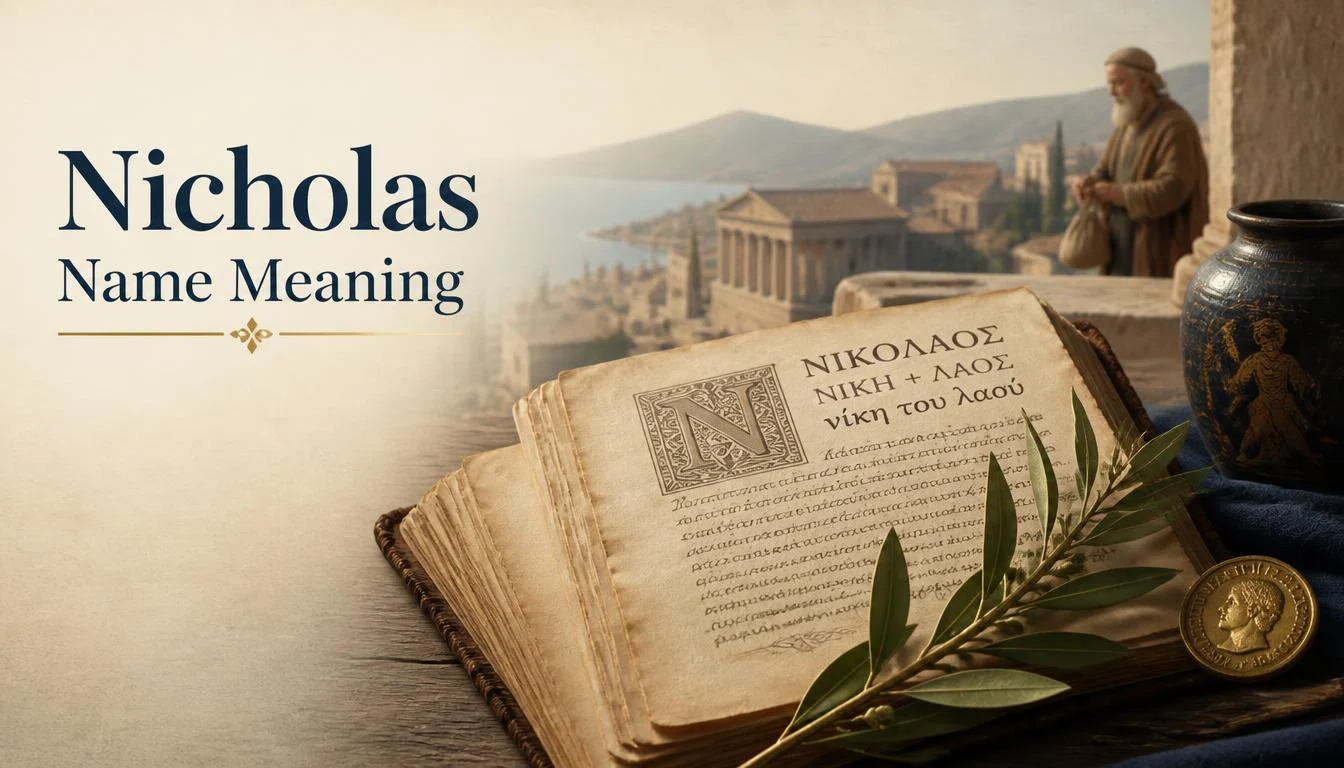
The Nicholas name meaning is “victory of the people,” from the Greek name Nikolaos. The name combines Greek elements associated with “victory” and “people,” giving Nicholas a strong, people centered meaning.
The Nicholas name meaning has deep Greek roots and a long history of use across different cultures. Derived from the Greek name Nikolaos, Nicholas combines elements associated with “victory” and “people,” giving the name the traditional meaning “victory of the people.” Its connection to Saint Nicholas, the Christian bishop associated with generosity and kindness, also helped the name gain lasting recognition throughout Europe and beyond.
Over the centuries, Nicholas has remained a familiar and respected choice because of its strong historical background and classic sound. The name appears in several forms across different languages, including Nicolas, Nikola, and Nikolai. In this guide, we’ll explore the Nicholas name meaning, Greek origin, history, religious connections, variations, pronunciation, popularity, and the qualities commonly associated with this enduring name.
Key Facts Box
| Detail | Information |
|---|---|
| Gender | Boy / Masculine |
| Meaning | Victory of the people |
| Origin | Greek |
| Original Form | Nikolaos (Νικόλαος) |
| Pronunciation | NIK-uh-luhs |
| Common Short Form | Nick |
| Related Forms | Nicolas, Nikolas, Nickolas |
| Cultural Association | Saint Nicholas and the Christmas tradition |
What Is the Name Nicholas?
Nicholas is a masculine given name with Greek roots. The original Greek form is Nikolaos (Νικόλαος), and the English Nicholas developed through historical forms of the name used across Europe.
The name is distinct from the modern English word “nick,” even though Nick commonly serves as its short form. Nicholas is also related to several international forms, including French Nicolas, Spanish Nicolás, Italian Niccolò, and Greek Nikolaos.
Nicholas Name Meaning
The Traditional Meaning
The traditional meaning of Nicholas is “victory of the people.” The first element comes from Greek nikē, meaning “victory,” while laos means “people.”
This gives Nicholas a meaning that feels broader than personal success. Instead of focusing only on an individual winner, the phrase connects victory with a larger group or community.
Modern Interpretation
Today, parents may choose Nicholas because of its established history as much as its literal meaning. The ideas of victory, strength, achievement, and connection with people naturally shape modern interpretations of the name.
At the same time, a name’s etymological meaning does not determine a person’s character. Nicholas carries these historical associations, but each person gives the name its own identity.
Origin and Etymology
Nicholas traces directly to the Greek name Nikolaos. Greek nikē means “victory,” while laos means “people.” Together, these elements produce the familiar interpretation “victory of the people.”
The Greek form appears as Νικόλαος, and related forms developed as the name moved through different languages and naming traditions. Latinized forms such as Nicolaus also played a role in the name’s European history.
As a result, Nicholas belongs to a large international family of names. The differences in spelling reflect language and pronunciation rather than a completely different origin.
History and Cultural Context
Saint Nicholas gave the name a major place in European Christian tradition. Historical tradition identifies him as a fourth-century bishop from Myra in Anatolia, in what is now Turkey. Stories about his generosity helped establish his reputation as a protector and giver.
Over time, devotion to Saint Nicholas spread widely. The name became established in England by the 12th century and continued to appear throughout Christian Europe. It also became associated with several popes and Russian rulers.
The connection with Christmas developed much later. Saint Nicholas traditions contributed to the Dutch figure Sinterklaas, which helped shape the modern Santa Claus tradition. Consequently, the name Nicholas carries both an ancient Greek meaning and a strong Christmas-era cultural association.
That connection should not obscure the name’s older history. Nicholas existed as a Greek personal name before the later traditions surrounding Saint Nicholas and Santa Claus.
Examples of Nicholas in Use
Nicholas works naturally in both formal and everyday settings. It can suit a traditional naming style while still offering several casual short forms.
For example:
- Nicholas James Carter a formal full name combination.
- Nick Carter a shorter, conversational form.
- Nicholas was named after his grandfather. ordinary sentence usage.
- Saint Nicholas traditions influenced Christmas customs. historical usage.
- Nikolaos the Greek form of the name.
The short form Nick has become an independent-feeling name in English, although it remains historically connected to Nicholas.
Variants and Spellings
Nicholas has numerous established forms across languages. These variations reflect different linguistic traditions and pronunciation patterns.
| Language or Tradition | Form |
|---|---|
| English | Nicholas |
| French | Nicolas |
| Greek | Nikolaos |
| Spanish | Nicolás |
| Italian | Niccolò / Nicola |
| German | Nikolaus |
| Polish | Mikołaj |
| Russian | Nikolai / Nikolay |
| Ukrainian | Mykola |
| Czech | Mikuláš |
| Irish | Nioclás |
| Portuguese | Nicolau |
Several English spellings also exist, including Nickolas and Nikolas. Common short forms include Nick, Nic, Nicky, and Nik.
The feminine forms Nicola and Nichola also developed in English, particularly in British usage.
Famous People Named Nicholas
Several notable people have carried the name Nicholas:
- Nicholas II the last emperor of Russia, who ruled from 1894 until his abdication in 1917.
- Nicholas Sparks American novelist known for romantic fiction, including The Notebook.
- Nicholas Hoult English actor known for film and television roles.
- Nicholas Winton British humanitarian who helped rescue hundreds of children from Nazi-occupied Czechoslovakia before World War II.
- Nicholas Kristof American journalist and author known for international reporting and commentary.
These individuals show how the name appears across royalty, literature, entertainment, journalism, and humanitarian work.
Nicholas vs. Related Terms
| Term | Meaning | How It Differs |
|---|---|---|
| Nicholas | Victory of the people | English form of the Greek Nikolaos |
| Nicolas | Same traditional name and meaning | Common French and Spanish-related form |
| Nikolaos | Greek form of Nicholas | Closest form to the original Greek name |
| Nick | Short form of Nicholas | Informal English form |
| Nikolas | Variant spelling of Nicholas | Alternative spelling used in several languages |
| Nicola | Related form of Nicholas | Used as a masculine name in some countries and as a feminine name in English |
The related forms share the same historical naming family, although their spelling, pronunciation, and gender usage can vary by language.
FAQs
What does the name Nicholas mean?
Nicholas traditionally means “victory of the people.” The name comes from the Greek Nikolaos, combining elements associated with victory and people.
Is Nicholas a biblical name?
Nicholas has Greek origins and is strongly connected with Christian history through Saint Nicholas. A person named Nicolaus also appears in the New Testament in Acts 6:5, but the modern name’s major Christian association comes from Saint Nicholas of Myra.
What is the origin of the name Nicholas?
Nicholas comes from the Greek name Nikolaos (Νικόλαος). Its traditional elements are Greek nikē, meaning “victory,” and laos, meaning “people.”
Is Nicholas a boy’s name or a girl’s name?
Nicholas is traditionally a masculine or boy’s name. Related feminine forms include Nicola and Nichola in English usage.
What is the nickname for Nicholas?
The most familiar nickname is Nick. Other established short forms include Nic, Nik, and Nicky.
How do you pronounce Nicholas?
Nicholas is commonly pronounced NIK-uh-luhs. Some speakers use a slightly shorter middle sound, producing a pronunciation closer to NIK-luhs.
Is Nicholas the same as Nicolas?
Nicholas and Nicolas belong to the same name family and share the same Greek origin. Nicholas is the standard English spelling, while Nicolas appears especially in French and other language traditions.
Conclusion
Nicholas is a classic Greek-origin name meaning “victory of the people.” Its history reaches from the Greek Nikolaos to Saint Nicholas and the traditions that later influenced Santa Claus. With international forms such as Nicolas, Nikolaos, and Nikolai, the name has remained recognizable across languages and generations.
Read More Articles
- Sadie Name Meaning | Biblical Roots, Origin and Symbolism In 2026
- Rebecca Name Meaning | Biblical Origin, History, and Symbolism In 2026











1 thought on “Nicholas Name Meaning | History, Personality and Cultural Significance In 2026”